
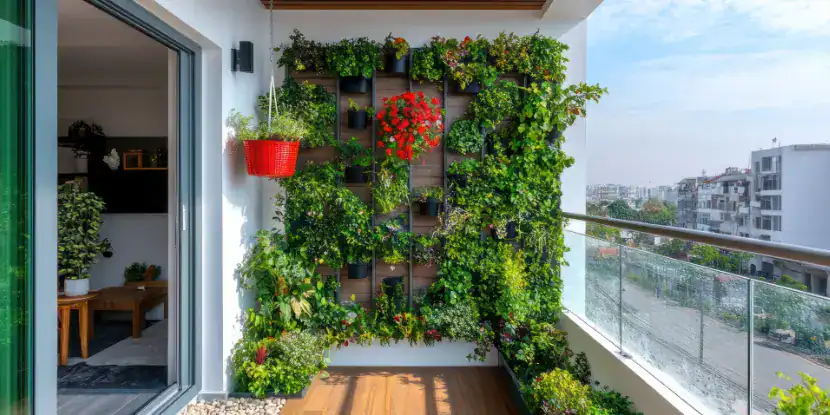
When space is limited, gardening often feels like a compromise. You squeeze a few plants into a corner, or perhaps you can only grow one or two. But vertical gardening is the opposite. The concept is simple: instead of covering the ground with plants, you utilise the vertical space. Walls, railings, hanging points—often unused areas—become part of your planting space.
I didn’t truly graspe ideas until my small balcony became too small. I rearranged the pots in an attempt to “make room,” but I realised I was thinking in two dimensions. When I started working vertically instead of horizontally, everything became more functional—and, frankly, more enjoyable.
Why Vertical Gardening Works So Well on Balconies
Small balconies have one major limitation: floor area. But height is usually underused. Vertical gardening solves this problem by using the following methods:
- freeing up walking space
- improving light exposure for some plants
- allowing better organization of plant types
There’s also a less obvious benefit: airflow. When plants are stacked thoughtfully, air circulates better than when everything is crowded on the ground.
Important insight:
Vertical setups don’t just save space—they change how your plants interact with light, wind, and moisture.
Wall-Mounted Planters:
Walls are often the most wasted part of a balcony.
How they help
Wall-mounted planters allow you to:
- grow multiple small plants in layers
- keep plants off the floor entirely
- create a structured layout without clutter
They work especially well for:
- herbs
- small leafy plants
- decorative greenery
Practical experience
When I first tried wall planters, I made the mistake of spacing them too tightly. It looked lovely at first, but watering became messy and uneven. Later, I learned that leaving enough space between containers makes maintenance easier and reduces water runoff issues.
Hanging Pots: Simple but Highly Effective
Hanging pots are one of the easiest vertical gardening methods to start with.
Why they work
They:
- use ceiling or railing height
- reduce floor congestion
- add visual layers to your garden
They’re especially useful for trailing plants that naturally grow downwards.
What most beginners miss
Wind exposure is stronger at higher levels. So hanging plants often dry out faster than floor-level ones.
That means:
- check moisture more frequently
- avoid placing them in strong wind paths
- choose slightly more stable containers
Balcony Rail Planters: Using the Edge Space
Balcony railings are often overlooked, but they’re one of the most practical vertical growing areas.
What makes them useful
Rail planters:
- don’t take floor space
- get good sunlight exposure
- are easy to install and adjust
They’re ideal for:
- herbs
- compact flowering plants
- shallow-rooted vegetables
Non-obvious insight
Rail planters dry out faster than you expect because they’re exposed on all sides. I noticed this when I kept losing smaller plants, even though I was watering them regularly. The issue wasn’t neglect—it was exposure.
Vertical Stacking Shelves: Controlled Layer Gardening
Plant shelves are one of the most structured ways to build vertically.
Why shelves are powerful
They allow:
- organized plant grouping
- better control over light placement
- separation of plant types
You can place:
- light-loving plants on top
- shade-tolerant plants lower down
Real-life adjustment tip
One mistake I made early on was stacking shelves too closely. It looked efficient, but airflow suffered. Plants on lower levels started showing moisture-related issues. Increasing spacing resolved the problem instantly.
Hanging Wall Grids and Mesh Panels
This method is a more flexible approach compared to fixed planters.
How they work
You attach a grid or mesh to a wall and hang the following:
- small pots
- plant holders
- lightweight containers
Why this method stands out
It’s highly adjustable. You can:
- rearrange plants easily
- swap containers based on growth
- experiment with layout without rebuilding anything
Practical observation
This method works best when you avoid overloading it. Too many containers create uneven weight and make watering harder to manage.
Ladder-Style Plant Stands: Compact Vertical Layers
Ladder stands are one of the simplest vertical gardening solutions.
Benefits
- minimal setup effort
- natural tiered spacing
- easy mobility
They’re especially useful if you rent or plan to move plants around frequently.
What I noticed over time
Plants placed on upper levels tend to dry faster due to airflow and light exposure. Rotating plants between levels every few weeks helps balance growth.
Combining Methods
The best setups rarely use just one idea.
A practical balcony setup often combines the following:
- wall planters
- rail pots
- a small shelf system
- hanging containers
This approach creates layers instead of clutter.
Key insight
Vertical gardening works best when you think in zones, not just objects.
- upper zone: hanging and sun-heavy plants
- middle zone: shelves and wall planters
- lower zone: stable, moisture-retaining pots
Common Mistake: Overcrowding Vertical Spaces
This is where many beginners go wrong. Just because you can stack more plants doesn’t mean you should.
Overcrowding leads to the following:
- poor airflow
- uneven watering
- hidden pest issues
- difficult maintenance
I learnt this lesson after trying to “fill every gap”. The garden looked impressive for a week, then became hard to manage. Sometimes leaving empty space improves plant health more than adding another pot.
Maintenance Reality: Vertical Gardens Need Small Adjustments
Vertical setups are not “set and forget”.
You’ll need to:
- rotate plants occasionally
- check water distribution carefully
- adjust placement based on growth
But maintenance is usually easier once the system is stable because everything is organised vertically instead of scattered.
Conclusion:
Vertical gardens are more than just a space-saving trick; they completely transform the way you use your balcony. You no longer have to worry about a lack of space; instead, you can create a sense of depth.
- Walls become planting surfaces.
- Railings become planters.
- Height is your greatest asset.
Even a small balcony will feel much more spacious if you utilise the vertical space. The goal is to use height to keep plants healthy and easy to maintain, rather than filling every single inch of space.
FAQs
1. Are vertical gardens suitable for beginners?
Yes. Simple setups such as rail systems or hanging planters are perfect for beginners.
2. Do vertical gardens need to be watered more often?
Generally yes, especially if the planters hang higher or are exposed to the elements, because they dry out faster.
3. Where on a balcony is the best place for a vertical garden?
A spot with sufficient sunlight and adequate ventilation, usually along a wall or railing.
4. Can I grow vegetables in a vertical garden on the balcony?
Yes, especially small vegetables and herbs that do not require deep soil.
5. What are the most significant mistakes people make with vertical gardens?
Overcrowding and a lack of air circulation, which leads to maintenance issues and poor plant growth.