
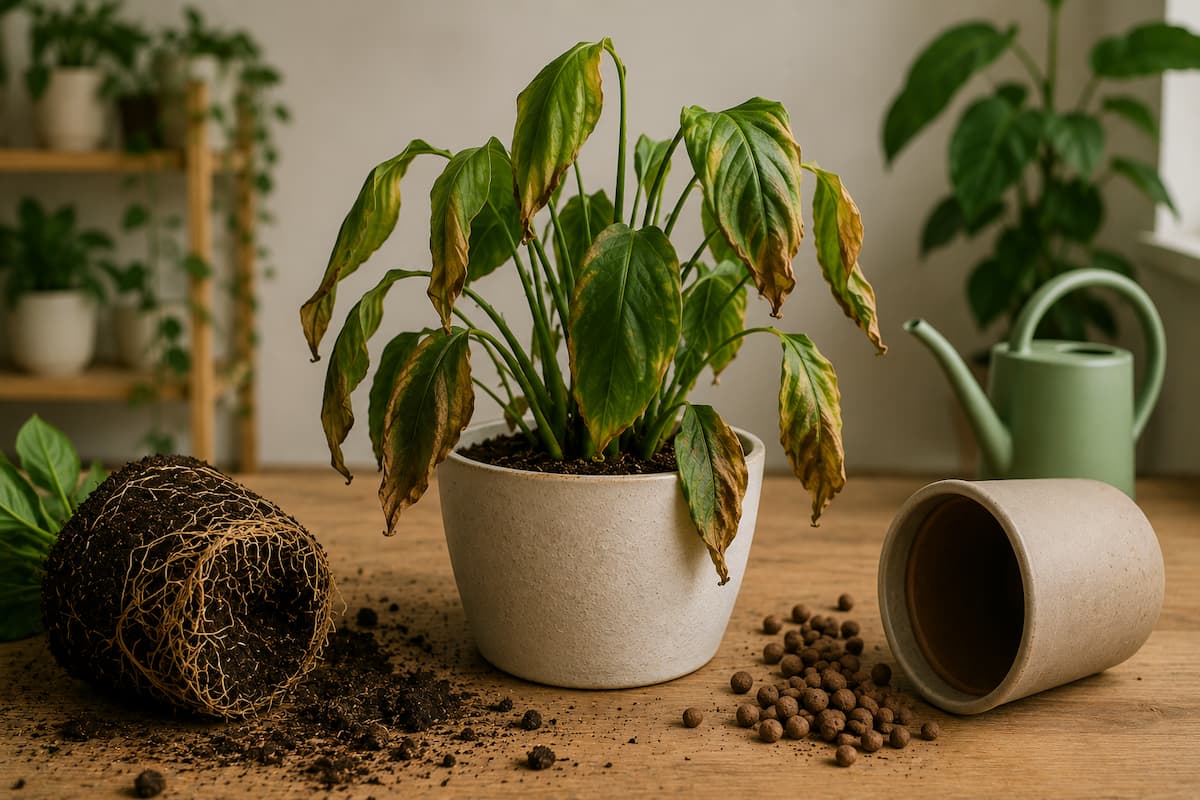
There’s a strange moment many plant owners notice after repotting: everything looks fine at first, the plant seems settled in its new container, and then within days or weeks, leaves start drooping, edges turn dry, or growth simply pauses. It feels like the plant is rejecting its upgrade.
In reality, what looks like “failure” is usually a transition struggle. Repotting is one of the most stressful events in a plant’s life, even when done carefully. The roots are disturbed, the environment changes, and the plant has to rebuild its stability from scratch.
Most repotted plants don’t die because of the new pot — they struggle because their root system temporarily loses its balance between water absorption and energy use.
The Hidden Stress of Root Disturbance
When a plant is removed from its original container, even gentle handling causes tiny breaks in the root hairs. These fine structures are responsible for absorbing most of the water and nutrients.
Once damaged, the plant cannot function at full efficiency for a while. It enters a recovery phase where survival becomes more important than growth. This is why a plant that looked healthy before repotting may suddenly appear weak afterward.
Root shock is not a disease. It is a temporary physiological response to environmental disruption.
Soil Change Creates an Adjustment Problem
Another overlooked reason plants struggle after repotting is the difference in soil composition. Even if the new soil is high quality, it is still different from what the plant was used to.
Old soil might have been denser or more moisture-retentive, while new soil may drain faster or contain different nutrients. The roots need time to adapt their water intake behavior.
| Soil Change Factor | Effect on Plant |
|---|---|
| Looser soil structure | Faster drying, potential underwatering stress |
| Denser soil mix | Risk of overwatering and root suffocation |
| New nutrients | Temporary imbalance in growth response |
Pot Size Mistakes That Slow Recovery
A surprisingly common issue is choosing a pot that is too large. While it may seem logical to give a plant “room to grow,” extra space can actually slow adjustment.
In oversized pots, the soil retains more moisture than the roots can use. This creates a damp environment that increases the risk of root stress or rot. On the other hand, pots that are too small can restrict root expansion, causing the plant to remain stressed and unable to stabilize.
A pot that is only 1–2 inches wider than the previous one is usually ideal for most indoor plants.
Watering Confusion After Repotting
Watering is where many plant owners unintentionally create problems after repotting. The root system is already weakened, so it cannot handle inconsistency well.
Some people overwater to “help the plant settle,” while others avoid watering too much out of fear of rot. Both approaches can slow recovery. Fresh soil also behaves differently — it may hold moisture longer or dry out faster than expected. This makes early watering decisions tricky.
Light Shock and Environmental Change
Plants are sensitive not only to soil changes but also to shifts in their environment. If a plant is moved during repotting, even slightly different light levels can affect its adjustment.
For example, a plant moved from a shaded corner to a brighter spot may experience leaf stress. Similarly, sudden exposure to direct sunlight can scorch leaves that were previously adapted to low light. Temperature and airflow also play a role. Drafts, heaters, and air conditioners can all interfere with recovery.
Root Binding and Sudden Freedom
Before repotting, many plants are root-bound — their roots are tightly packed and used to limited space. When suddenly moved into a larger container, they experience a kind of “freedom shock.”
This sudden change means the roots must spread out into unfamiliar soil. Until they re-establish a stable network, the plant may slow down visibly.
A tightly packed system suddenly expanded needs time to reorganize before it functions efficiently again.
Fertilizer Mistakes After Repotting
New plant owners often assume fertilizer will help recovery, but this is one of the most common mistakes. Fresh potting soil already contains nutrients, and adding more too soon can overwhelm the plant.
Excess nutrients can burn weakened roots and slow down the healing process rather than support it. Most plants benefit from waiting several weeks before any fertilizing begins.
Why Leaves Show Stress First
When a plant struggles after repotting, the first visible signs usually appear in the leaves. This is because leaves are the most sensitive indicators of internal imbalance.
Common symptoms include:
- Drooping or soft leaves
- Yellowing edges
- Slow or stopped growth
- Leaf drop in severe cases
These symptoms are not always permanent damage. In many cases, they are temporary responses to root adjustment.
Table: Common Causes of Repotting Stress
| Cause | What Happens | Result |
|---|---|---|
| Root disturbance | Fine roots break | Reduced water uptake |
| Soil change | Different drainage & nutrients | Adjustment delay |
| Overwatering | Soil stays wet too long | Root stress |
| Too much fertilizer | Salt buildup | Leaf burn & weakness |
How Long Does Adjustment Take?
There is no fixed timeline for recovery after repotting. Some plants bounce back within a week, while others take several weeks or even months to fully stabilize.
Fast-growing plants often recover more quickly, while slow-growing tropical varieties may take longer to adjust. The key indicator is new growth. When a plant begins producing healthy new leaves or stems, it is a sign that its root system has regained stability.
Supporting a Smooth Recovery
Although repotting stress cannot be completely avoided, it can be minimized. The goal is to reduce additional stress while the plant adapts internally.
Stable watering habits, moderate light, and avoiding unnecessary movement are usually enough to support recovery. Most importantly, patience plays a major role. Plants do not respond instantly, and forcing changes too quickly often creates more harm than benefit.
Final Reflection
When a newly repotted plant seems to struggle, it is rarely a sign of failure. It is more accurately a period of recalibration. The root system is reorganizing, the soil is settling, and the plant is slowly learning its new environment.
Understanding this process helps reduce panic and prevents overcorrecting with water, fertilizer, or constant repositioning. In most cases, the best action is simply to give the plant time and consistency.
Sources and References
- Royal Horticultural Society (RHS) – Repotting Houseplants Guidelines
- University of Florida IFAS Extension – Indoor Plant Care
- Missouri Botanical Garden – Houseplant Stress and Recovery
- Clemson Cooperative Extension – Container Gardening Basics
- Penn State Extension – Water Management in Container Plants
Disclaimer: This article is intended for general educational purposes about indoor plant care and is based on widely accepted horticultural practices.