
Most people do not kill houseplants because they lack care. They kill them because they lack rhythm. Watering happens on Tuesday one week, Friday the next, and then not at all for ten days because life intervenes. Fertilizer is applied when someone remembers the bottle exists, which usually means twice in one month and then never again. Repotting happens in a panic when roots are already bursting through the drainage holes. This is not neglect in the traditional sense. It is the absence of a system.
A plant care schedule does not need to be elaborate. It does not need color-coded spreadsheets or smartphone apps with push notifications. What it needs is regularity — a predictable rhythm that your plants can rely on and that you can actually maintain without stress. The goal is not perfection. The goal is consistency, because plants respond to patterns far more than they respond to intensity.
Start With Your Life, Not Your Plants
Before you assign a single watering day, look at your actual week. Are you home every Sunday morning with coffee and time to spare? Or does Sunday disappear into errands and family obligations? Do you travel frequently for work? Do you have roommates or family members who might help, or who might overwater out of enthusiasm?
Be honest about this. A schedule that looks beautiful on paper but conflicts with your real life is a schedule that will fail within a month. If you are rarely home, choose drought-tolerant plants like snake plants, ZZ plants, or succulents that forgive irregular attention. If you are home often and enjoy the ritual, you can support more demanding species like ferns or calatheas. The schedule must fit the person before it can fit the plant.
The Weekly Ritual: One Day, One Task
The foundation of any simple plant care schedule is a single weekly check-in day. Choose a day and time that feels natural — Sunday morning, Wednesday evening, or whatever slot is least likely to be hijacked by other demands. This is your plant care day, and it should last no more than fifteen to twenty minutes for a modest collection.
On this day, you do four things in order:
- Check soil moisture. Stick your finger into the top inch or two of soil. If it feels damp, skip watering. If it is dry, proceed. This is the only test that matters. Do not water on a calendar. Water on evidence.
- Water thoroughly if needed. Apply water until it runs from the drainage holes. This ensures the entire root ball is saturated, not just the surface. Let the pot drain completely before returning it to its saucer.
- Inspect leaves. Look for yellowing, browning, wilting, or spots. Check the undersides of leaves for pests like spider mites or mealybugs. Remove any dead or damaged foliage.
- Rotate the pot. Turn it a quarter turn so all sides receive equal light. Plants naturally lean toward their light source, and rotation keeps them growing straight and balanced.
That is the entire weekly routine. Fifteen minutes. No more, no less. If you have plants with completely unique needs — a cactus that wants water every three weeks and a fern that wants it twice a week — you can add a midweek check for the thirsty ones, but keep the main ritual simple. Complexity is the enemy of consistency.
The Monthly Deep Check
Once a month, set aside thirty to forty minutes for maintenance that goes beyond the weekly routine. This is when you handle the tasks that do not need weekly attention but should not be ignored indefinitely.
Your monthly checklist:
- Dust the leaves. Wipe them gently with a damp cloth. Dust blocks light absorption and can harbor pests. For fuzzy-leaved plants like African violets, use a soft brush instead of a cloth.
- Inspect thoroughly for pests. Look under leaves, along stems, and at soil level. Early detection is the difference between a quick wipe with neem oil and a full-blown infestation.
- Prune dead or leggy growth. Remove yellowing leaves and trim stretched stems. This redirects energy to healthy growth and keeps the plant looking tidy.
- Check soil level and condition. If the soil has settled significantly or looks depleted, top it off with fresh potting mix. If the surface is crusted with mineral deposits from hard water, scrape it away gently.
Some plant owners also use the monthly check to give larger plants a “”bath”—placing them in the bathtub and showering them gently to simulate rain, clean the leaves, and flush accumulated salts from the soil. This is optional but beneficial, especially for plants that have been in the same pot for a while.
The Annual Reset: Spring Preparation
Once a year, ideally in early spring when most houseplants enter their active growing phase, perform a deeper round of care. This is your annual reset, and it sets the tone for the growing season ahead.
Spring tasks include:
- Repot if needed. If roots are circling the pot or growing through drainage holes, move the plant to a container one size larger with fresh potting mix. Do not repot unless necessary — most easy-care plants are fine for two to three years in the same pot.
- Resume or increase feeding. If you fertilize, spring is when you begin or increase frequency. Use a gentle, balanced fertilizer and follow the label dilution exactly. Over-fertilizing damages roots more than under-fertilizing.
- Review your collection. Are your current plants thriving? Have your conditions changed—new windows, different heating, a move to a new home? Adjust your plant choices and your schedule accordingly.
Seasonal Rhythm Reminder: In winter, growth slows and water needs drop by about half. Reduce watering frequency and hold off on fertilizer entirely until spring. In summer, heat and increased light may mean slightly more frequent watering, but always assess the soil first. The schedule is a framework, not a mandate. Let the plant and the season guide the specifics.
Staying Consistent Without Obsessing
The hardest part of any schedule is not creating it. It is maintaining it when motivation fades. The novelty of a new plant collection wears off after a few weeks. The weekly check-in starts to feel like a chore. This is where structure matters more than enthusiasm.
Practical habits that keep you on track:
- Keep tools in one place. Store your watering can, pruning scissors, cloth, and any fertilizer in a single spot. Friction kills habits. If you have to hunt for supplies, you will skip the task.
- Use simple reminders. A phone alarm or calendar notification for your weekly and monthly checks is enough. You do not need a specialized app. The reminder is a nudge, not a command.
- Label your plants. Small tags with basic care notes—”water when dry,” “likes humidity,” “rotate weekly”—remove the mental load of remembering each plant’s preferences. This is especially helpful if you have more than five or six plants.
- Group plants by need. Place all your drought-tolerant plants together and your humidity lovers together. This makes the weekly check faster and reduces the chance of overwatering a cactus because it sits next to a fern.
What a Simple Schedule Actually Looks Like
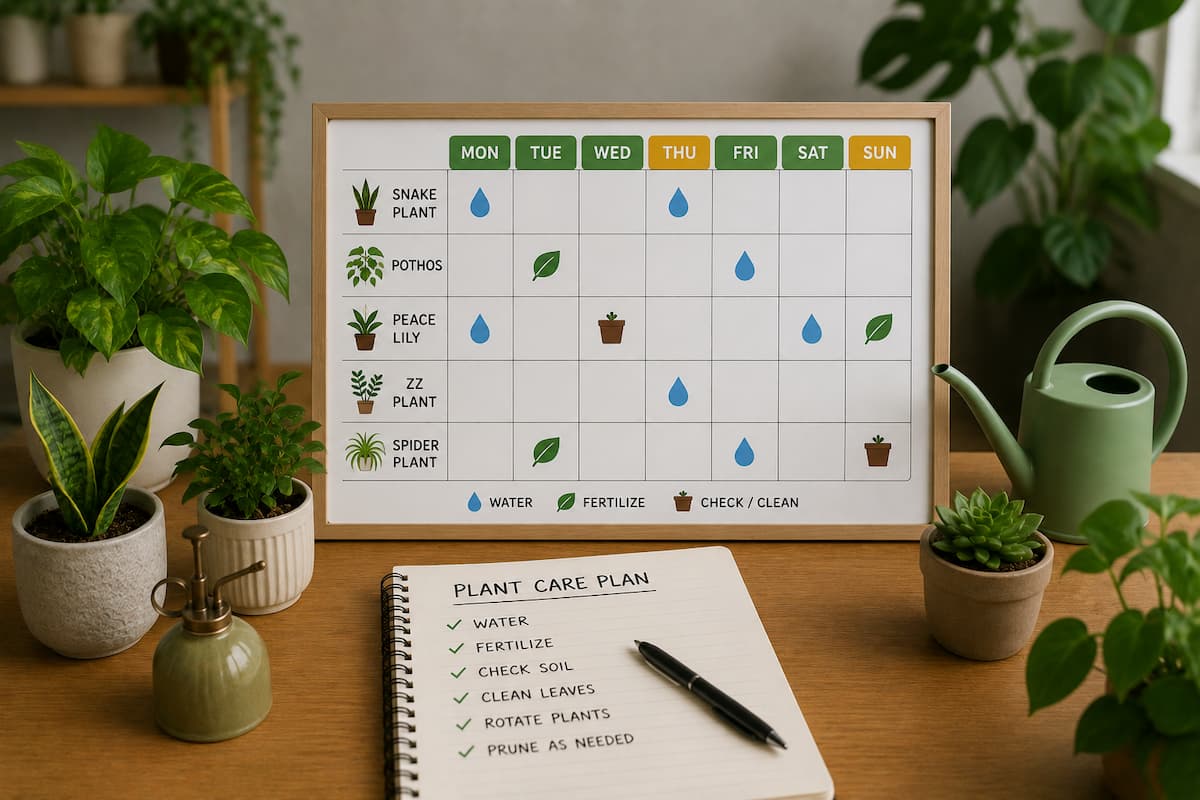
Here is a concrete example for someone with a small collection of easy-care plants — a pothos, a snake plant, a ZZ plant, and a spider plant — living in a typical apartment with moderate light.
Every Sunday morning, 10 minutes: Check soil on all four plants. Water any that are dry. Rotate each pot. Remove any dead leaves. Done.
First Saturday of each month, 30 minutes: Dust leaves. Inspect for pests. Prune any yellowing growth. Check if any plants need repotting or soil refresh. Note any concerns in a simple notebook or phone memo.
Mid-March, one afternoon: Repot anything that has outgrown its container. Resume fertilizer if you use it. Review the collection and decide if any plants need to be moved to better light or given away if they are struggling.
That is the entire system. No daily tasks. No complex tracking. Just a weekly rhythm, a monthly check, and an annual reset. The plants do not need more than that, and neither do you.
Warning Against Over-Scheduling: Do not create a separate schedule for every plant. Do not track watering dates in a spreadsheet. Do not weigh your plants or measure soil moisture with a digital meter unless you genuinely enjoy the process. For easy-care houseplants, these practices add complexity without adding value. The finger test and a single weekly day are sufficient. Anything more is hobby behavior, not care behavior, and there is nothing wrong with that — but recognize the difference.
A schedule that works is one you will actually follow. It does not need to be clever or comprehensive. It needs to be boring enough that you stop thinking about it and just do it. The plants will notice the difference, even if you do not. They will grow more evenly, produce more leaves, and resist pests more effectively simply because their environment has become predictable. That predictability is what they have been waiting for. It is also what you have been waiting for — the freedom to enjoy your plants without the low-grade anxiety of wondering whether you forgot to water them.
About This Article: This guide was written for anyone who has bought a few houseplants with good intentions and then watched them slowly decline through inconsistent care. The schedule described here is based on standard horticultural practice and the routines recommended by plant care specialists. No brand affiliations exist. For plants with specific cultural needs — orchids, carnivorous plants, bonsai — consult specialized resources before applying a general schedule.
Sources and References
- Leaf Culture – How to Create a Simple Houseplant Care Schedule (March 2026)
- XOXO Jackie – Creating a Houseplant Care Routine (April 2024)
- The Old Farmer’s Almanac – Houseplant Guide: How to Care for Indoor Plants (September 2022)
- Mindful Slow Life – Indoor Plant Care Calendar: Month-by-Month UK Guide (November 2025)
- All About Planties – Year-Round Indoor Plant Care Calendar (December 2025)
- Plantlex – Seasonal Houseplant Care Calendar