
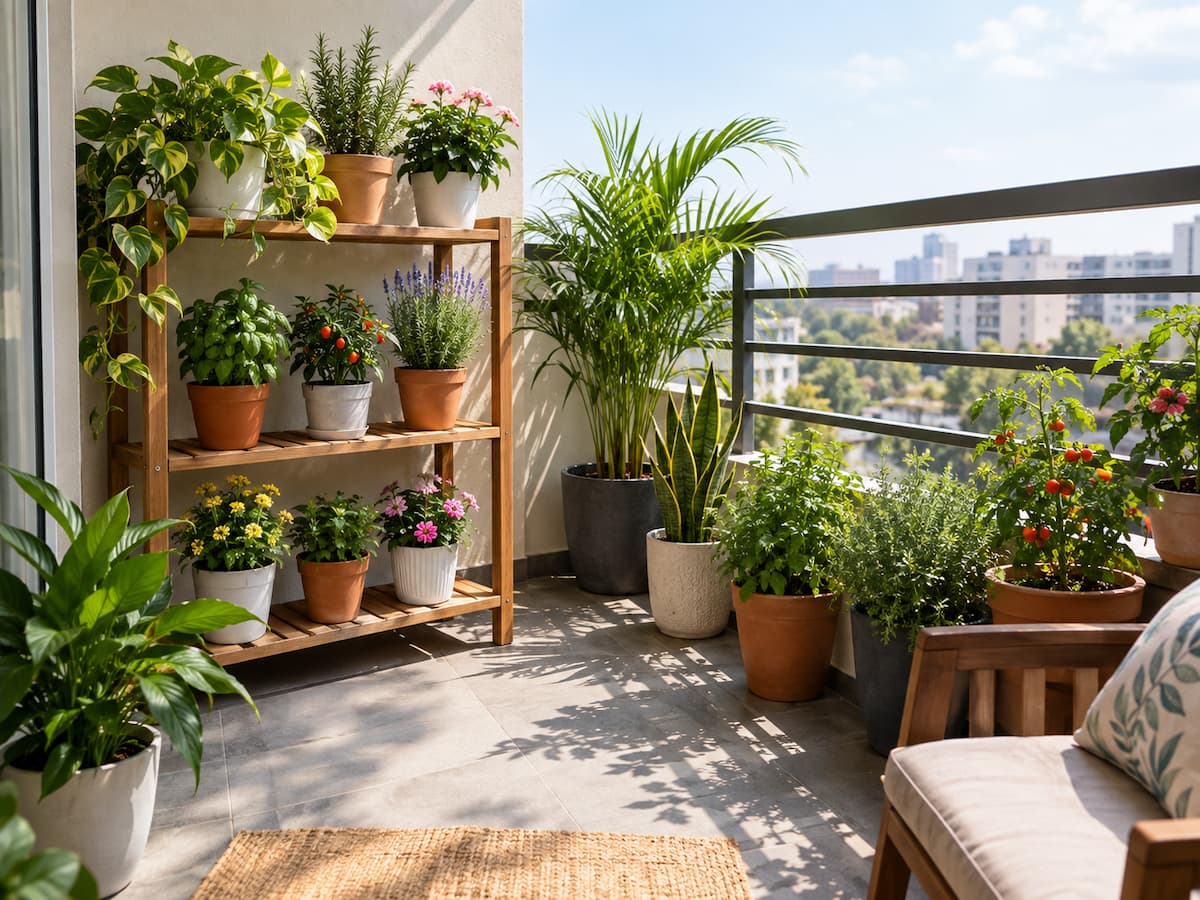
A balcony can look perfectly arranged when you first set out the plants. The pots may line the railing, the larger containers may sit neatly in the corners, and the smaller plants may fill the gaps. Then, a few weeks later, something changes. A tall plant begins shading the pot behind it, leaves from neighboring plants start touching, and the brightest part of the balcony becomes a crowded cluster while another area remains barely used.
The problem is often not the number of plants. It is where those plants are positioned in relation to the moving sunlight and the available air space. A useful balcony arrangement treats the floor, walls, railing, corners, and vertical height as one growing area. Instead of giving every plant the brightest-looking spot, you can distribute plants according to the light they actually need and leave enough room for air to move around their foliage. The arrangement may need adjustment as plants grow or as the sun changes with the season, but a thoughtful starting layout makes those adjustments much easier.
Watch the Balcony Before Moving the Pots
The first step is to observe rather than arrange. Sunlight that appears strong from one side of the balcony may reach only a narrow section of the floor, while a wall or neighboring building can create shade for several hours. Choose several points on the balcony and check them at different times of day. You do not need specialized equipment. Simply note where direct sunlight falls in the morning, around midday, and later in the afternoon. Pay attention to whether the light reaches the floor, railing, shelves, or only the upper parts of the space.
A simple observation can reveal useful differences:
- One corner may receive direct morning sun but become shaded later.
- The railing may remain bright while the floor behind it is shaded.
- A wall can block low-angle sunlight at certain times.
- A shelf can receive more light than a pot directly underneath it.
- A balcony may be bright overall but have only a few hours of direct sun.
Repeat these observations on more than one day if possible. A single day’s pattern does not necessarily represent the balcony throughout the year. The goal is not to produce an exact sunlight map. You are trying to identify the balcony’s brighter, partly shaded, and consistently lower-light positions before assigning plants to them.
Think About Mature Size, Not Just Today’s Pot
A common arrangement mistake is judging plants by the size they are when purchased. A small container may look harmless between two other pots, but the plant inside it can eventually produce leaves several times wider than the container.
This matters because plants compete for light above the soil, not simply for space at floor level. Imagine three containers arranged in a straight line from the railing toward the wall. If the tallest plant is placed at the front, its foliage may cast shade over the two plants behind it. If those plants require more direct light, the original arrangement can gradually become unsuitable even though nobody has moved a pot.
Before fixing a plant in position, consider its expected height and spread. Also consider whether it grows upright, branches outward, trails downward, or produces a broad canopy. A narrow upright plant and a low, wide plant can occupy similar floor space while affecting the surrounding light very differently. The mature shape is especially important when using shelves. A plant that looks ideal on an upper shelf can eventually extend into the space below, reducing both light and airflow around neighboring containers.
Give Tall Plants a Position That Does Not Create a Shade Problem
Tall plants do not automatically belong at the back of every balcony. Their best position depends on where the sunlight comes from and what plants are behind them. If sunlight generally comes from the railing side, putting a tall plant directly in front of several shorter sun-loving plants can create a large shadow. In that situation, shifting the tall container toward a side or corner may preserve more usable light.
Corners can be useful for tall plants because they can reduce the amount of central floor space occupied by a large container. But a corner is not automatically ideal. If two walls already make that area dark, adding a tall plant there may leave it with less useful light than expected. Use the balcony’s actual light pattern to decide.
Medium-height plants can fill the transition between tall containers and low-growing plants. Instead of creating a solid row of equal-height foliage, stagger the plants so that leaves have some open space between them. This creates a less crowded visual arrangement and gives sunlight more opportunities to reach lower foliage. Short plants are often easiest to place along open edges or in front of taller containers, provided they receive enough light for their particular needs. Avoid putting every small pot into the remaining gaps. A gap between two containers is not necessarily a good growing position.
Leave Space for Air to Move
Airflow is easy to overlook because a balcony may feel windy when you are standing there. Plants experience airflow differently, particularly when several containers are packed closely together. When leaves from neighboring plants form one continuous mass, air movement through the lower parts of the foliage can become limited. Moisture can also remain around leaves and stems longer than it would in a more open arrangement.
This does not mean every pot needs a large empty area around it. The practical aim is to prevent containers from becoming one tightly packed block. Look at the arrangement from above as well as from the side. If leaves overlap heavily, pots touch one another, and there is almost no visible space between plants, the arrangement may be too dense.
Allow enough room to:
- See some of the space between neighboring containers;
- reach each pot without pushing through foliage;
- remove a container without disturbing several others;
- Keep large leaves from permanently pressing against another plant;
- Maintain some open pathways for air around the foliage.
The required distance varies considerably with plant size and growth habit. A compact herb and a broad-leaved ornamental plant should not automatically receive the same spacing.
Use Different Balcony Positions for Different Jobs
The railing, floor, walls, shelves, and corners can each serve a different purpose instead of simply becoming places to put spare pots. A railing-side position may receive more direct light but can also expose a plant to stronger environmental conditions. For light planning, however, the important question is how much usable sunlight actually reaches the plant at that position.
Floor-level containers can be useful for plants that tolerate the available lower light, while taller plants can occupy areas where their foliage will not block several other containers. Shelves create another layer of space, but they require careful planning. An upper shelf can cast shade on everything below it, and a dense plant on that shelf can become an obstacle to airflow. Keep enough vertical separation for the plants to develop without turning the shelving into a solid wall of leaves. Walls can also create shade patterns that change during the day. A container placed close to a wall may receive less direct light than one only a short distance away, depending on the balcony’s orientation and surrounding buildings.
Avoid Building a Solid Wall of Foliage
A balcony filled with healthy plants can still be poorly arranged if the plants collectively form a dense screen. This often happens when containers are lined tightly along the railing. Each individual plant may have enough space for its roots, but their leaves merge into one continuous layer. The result can be reduced airflow through the middle of the planting area and uneven light distribution behind the row. Instead of treating the railing as a shelf that must be completely filled, leave deliberate openings. A staggered arrangement can be more effective than a solid line.
For example, on a narrow balcony receiving strong light from the open side, a tall plant at one end, medium plants through the middle, and lower containers toward the other side may allow more light to reach different levels. If two tall plants are needed, separating them can prevent their canopies from merging into one large block. The same principle applies indoors on a balcony shelf: several small plants packed tightly together can behave like one dense mass once they mature.
Morning Sun, Afternoon Sun, and Uneven Light Need Different Arrangements
Not all direct sunlight has the same practical effect on a balcony. A position that receives morning sun may lose direct light well before another position receives afternoon sun. Buildings, neighboring balconies, trees, walls, and the balcony’s orientation can create highly uneven conditions.
For a balcony with mainly morning sun, plants requiring more direct light may need to occupy the positions that receive that early exposure most reliably. Plants with lower light requirements can use areas that become shaded afterward, provided those conditions suit them.
An afternoon-sun balcony may have its brightest period later, so observe whether tall plants cast shadows across the containers before the main light period arrives. On a balcony with filtered light, arrangement becomes less about separating extreme bright and dark zones and more about making the most of limited usable light. Seasonal changes matter too. The sun follows a different path and reaches different angles across the year. A position that is sunny in one season may receive substantially less direct light in another. This is one reason a permanent arrangement should be treated as adjustable rather than final.
When Two Plants Want the Same Bright Spot
Sometimes two plants simply compete for the same location. Moving one immediately into a darker corner may solve the crowding problem but create a light problem. First compare their actual light requirements. If one plant needs substantially more direct light, give priority to that plant for the brighter position. The other can be moved to a location that still meets its needs rather than simply receiving whatever space is left.
Height can also solve some conflicts. If one plant can be positioned lower without losing necessary light, while the taller plant is moved to a position where its canopy does not shade the other, the two may coexist.
Another option is to rotate or rearrange containers periodically when conditions allow. This is particularly useful when a balcony has several partially suitable positions rather than one perfect spot. The key is to solve the competition based on the plants’ requirements, not on which container happens to look better in the brightest location.
Build the First Layout in Stages
Instead of arranging twenty containers at once, start with the largest plants. Place the tall containers first and observe the resulting shadows. Then add medium-height plants and check whether their foliage will eventually occupy the same space. Finish with shorter plants only after the larger structure makes sense.
Stand several steps back and look at the balcony from different angles. Then look underneath and between the plants. A layout that looks spacious from the doorway may be surprisingly crowded around the pots. After the initial arrangement, give the plants time to respond. Watch whether one plant begins shading another, whether foliage presses against neighboring plants, and whether you can still reach every container easily.
A plant may also provide clues that its position needs reconsideration. Persistent stretching toward one direction, noticeably sparse growth on the less-lit side, or a clear decline compared with its previous condition can indicate that the available light is not matching its needs. Such signs are not proof of a placement problem by themselves, since watering, temperature, plant health, and other factors can also affect growth, but they are worth investigating.
A Practical Balcony Placement Check
Before considering the arrangement finished, walk through this quick check:
- Identify where direct sunlight reaches during the main parts of the day.
- Match the brightest positions to plants that actually require the most light.
- Check the mature height and spread of the largest plants.
- Make sure tall foliage will not permanently shade important neighboring containers.
- Leave visible air space between dense groups of foliage.
- Check that shelves and upper containers do not create unexpected shade below.
- Keep a clear route to each pot for watering, pruning, and inspection.
- Recheck the arrangement as plants grow and as the season changes.
- If a large container is placed on or near a railing, make sure the support is appropriate for its weight and position rather than assuming the railing can safely carry it.
The last point is particularly important for large containers. Wet soil and a mature plant can make a container considerably heavier than it appears when first placed.
Treat the Arrangement as Something You Can Tune
There is rarely one perfect balcony layout that remains ideal all year. Plants grow, shadows move, sunlight changes with the seasons, and the conditions around the balcony may differ from what you initially observed. A better approach is to create a layout that gives you room to adjust. Keep the largest plants from blocking the entire growing area, avoid packing containers so tightly that moving one becomes a major task, and use the brighter and darker parts of the balcony according to each plant’s needs.
After several weeks, reassess the space. If one plant has become a light blocker, move it before it creates a larger problem. If two plants have grown into one dense mass, separate them. If a previously bright corner has become shaded by a neighboring plant, reconsider which container belongs there.
Good balcony arrangement is less about making every pot look perfectly positioned and more about distributing light and open space intelligently. Start by observing where the sun actually travels, plan around mature plant size, and leave enough room for air and access. Then let the growing plants tell you where the layout needs another adjustment.