
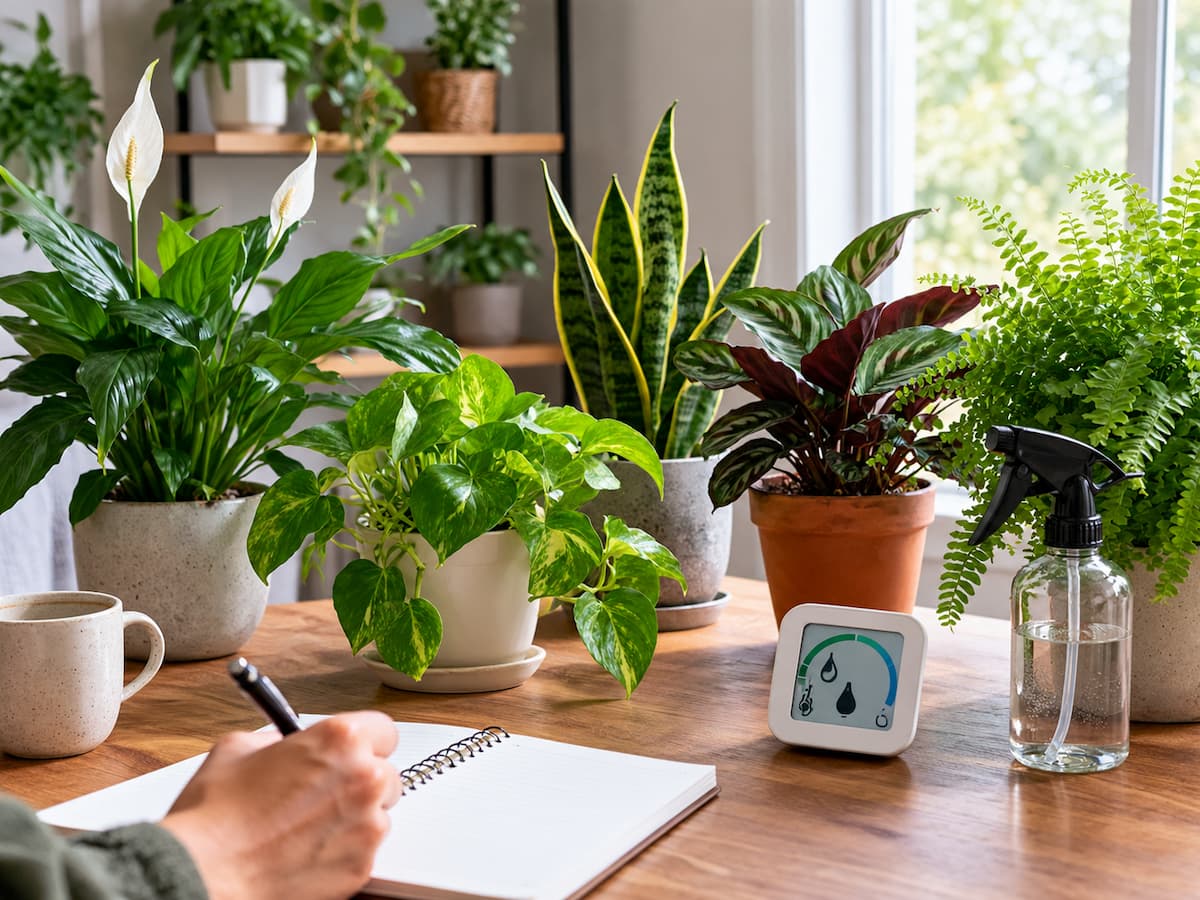
Imagine placing several attractive houseplants together on a living room shelf. At first, the arrangement looks healthy and balanced. After a few weeks, however, one plant develops dry, brown leaf edges, while another shows signs of trouble despite receiving regular attention. You may begin adjusting watering schedules, moving pots around, or misting the leaves, only to find that the plants still do not look equally happy.
The problem may partly involve the air around them. Some houseplants tolerate the relatively dry conditions found in air-conditioned rooms, while others grow better when the surrounding air holds more moisture. Grouping plants with similar humidity preferences can make their environment easier to manage, especially in homes where maintaining separate growing conditions is inconvenient. Humidity is not the only factor that affects plant health. Light, temperature, watering, drainage, and the condition of the roots also matter. However, considering humidity before arranging plants together can prevent avoidable problems and help you choose a group that suits your home.
What Humidity Means for Indoor Plants
Relative humidity describes how much water vapour is in the air compared with the maximum amount the air could hold at the same temperature. It is usually expressed as a percentage. For example, a relative humidity reading of 50% means the air contains about half the water vapour it could hold at that temperature. Plants lose water through tiny openings in their leaves called stomata. This process, known as transpiration, helps move water and nutrients through the plant. The surrounding humidity affects how quickly water can escape from the leaves. In dry air, water may leave the leaves more quickly, particularly when temperatures are high or air is moving rapidly.
Plants adapted to humid environments may respond poorly to prolonged dry indoor air. Their leaves can develop brown edges, curled tips, or other signs of stress. Some may also grow more slowly or produce smaller leaves. These symptoms are not proof of low humidity, though. Root damage, excess fertiliser, irregular watering, pests, and other conditions can cause similar changes.
Humidity Is Different From Watering
Humidity refers to moisture in the air. Watering supplies moisture to the potting mix around a plant’s roots. Water on a leaf is a third, separate condition. A room can have dry air while the potting mix remains wet. This may happen when a plant sits in an oversized pot, grows in a dense mix, or receives more water than its roots can use. Likewise, a room with relatively high humidity can contain plants whose potting mix dries quickly because they receive strong light or grow in small containers. These differences matter when grouping houseplants. Two plants may prefer similar humidity but need different amounts of water at their roots. Raising room humidity does not mean you should water them more frequently, and keeping their potting mix wet is not a reliable way to compensate for dry air.
Assess the Humidity in Your Home Before Choosing Plants
A house does not have one uniform humidity level. Conditions can differ from one room to another, and even two locations within the same room may experience different air movement and temperatures. A living room with frequent air-conditioning use may feel dry compared with a bathroom that receives regular showers. A bedroom with closed windows may behave differently from a kitchen with an exhaust fan. Rooms near heating or cooling vents can also have conditions that differ from areas farther away.
Seasonal changes introduce another variable. Air brought indoors from outside can be relatively dry during some seasons, while humid weather may increase indoor moisture. Air-conditioning can remove moisture from the air, and heating can lower relative humidity by warming indoor air without adding water vapour. The actual effect depends on the building, climate, ventilation, and equipment.
Use a Hygrometer Instead of Guessing
A basic digital hygrometer measures relative humidity and usually displays the temperature as well. It can help you compare rooms and understand whether conditions remain fairly stable or change throughout the day. Place the meter near the area where you intend to keep the plants, but not directly beside a humidifier, in sunlight, against a cold window, or in the direct airflow of a vent. These locations may produce readings that do not represent the conditions around the whole group.
Take readings at different times and repeat them over several days. A single measurement cannot show whether the room becomes much drier overnight or when the air-conditioning runs. If possible, compare readings during different weather conditions or seasons.
A hygrometer is useful, but it has limits. Inexpensive meters may not be perfectly accurate, and a reading from one location cannot describe every corner of a room. The meter also cannot tell you whether a particular plant is healthy or whether its leaves are responding to another problem. Human comfort is an unreliable substitute. A room that feels comfortable to you may still have relatively dry air for a humidity-sensitive plant. Conversely, a room that feels humid does not necessarily provide the right conditions for every tropical species.
Choose Plants by Their Broad Humidity Preferences
For practical grouping, divide potential houseplants into three broad categories: plants that generally tolerate ordinary indoor humidity, plants that benefit from moderately humid conditions, and plants that are more demanding about humidity. These categories are guides rather than fixed botanical rules. Different species, cultivars, growing conditions, and levels of acclimation can affect how a plant responds. A plant raised in a greenhouse may need time to adjust to a home, while an established specimen that has adapted to indoor conditions may tolerate a wider range.
Plants That Usually Tolerate Ordinary Indoor Air
Start with this group if your home has air-conditioning or seasonal heating or no plans for a humidifier. Many common foliage plants tolerate the humidity found in ordinary living spaces, provided their other needs are met. Examples include many snake plants, ZZ plants, and some common pothos varieties. These plants are often adaptable, but that does not mean they are immune to very dry air or sudden environmental changes.
A useful approach is to select plants that have already grown successfully under conditions similar to those in your home. Ask the seller about the growing environment when possible, and inspect the plant for healthy leaves, sound stems, and signs of pests before bringing it home. This group is often the simplest choice for shelves, desks, and living rooms where humidity cannot be controlled precisely.
Plants That Prefer Moderately Humid Conditions
Some popular foliage plants grow well in ordinary homes but generally benefit from more consistent moisture in the air. Examples may include many peace lilies, some philodendrons, and certain tropical foliage plants. These plants can be suitable companions when a room has moderate humidity and reasonable air movement. However, their response varies by species and growing conditions. A peace lily that tolerates a typical living room may still struggle in a very dry room beside a heating vent.
If you want a mixed arrangement, combine plants from this broad group with adaptable plants only when their light, temperature, and watering needs also fit the location. Do not assume that a plant described as tropical automatically needs a specialised humid environment.
Plants That Need More Humid Conditions
Some plants are more sensitive to prolonged dry air. Certain calatheas, marantas, and delicate tropical ferns are examples that may develop leaf-edge damage or other symptoms when humidity is too low for their growing conditions. These plants can be rewarding, but they may be harder to maintain in rooms that become very dry. Grouping several compatible plants in a naturally humid area may help, although it does not guarantee that the humidity will remain adequate.
If a plant repeatedly struggles in your main living space despite appropriate watering, light, and temperature, consider whether a different room would suit it better. For a humidity-sensitive plant, a stable environment may be more useful than frequent attempts to correct changing conditions.
Houseplant Humidity Compatibility at a Glance
The following table provides a starting point for comparing plant groups. The suitability ratings describe general grouping possibilities, not guaranteed results for every species.
| General humidity preference | Typical environmental considerations | Grouping suitability | Practical cautions |
|---|---|---|---|
| Broad tolerance of ordinary indoor humidity | Usually adaptable to typical living rooms and bedrooms | Often suitable for mixed arrangements with other adaptable plants | Very dry air, hot drafts, and abrupt changes can still cause stress. |
| Moderate humidity preference | Benefits from reasonably stable indoor conditions and protection from harsh airflow | Often suitable for groups of compatible tropical foliage plants | Similar humidity preferences do not ensure identical watering needs. |
| Higher humidity preference | May respond poorly to prolonged dry air, especially near heating or cooling vents. | Best grouped with plants that have similarly demanding environmental needs | A dry room may require relocation or controlled humidity. |
| Humidity-sensitive plants with additional specialised needs | May require particular combinations of humidity, temperature, airflow, or other conditions | Better suited to a carefully selected group or separate growing area | General labels such as ‘tropical’ or ‘fern’ are not precise enough to determine requirements |
Some growers use approximate relative humidity ranges when planning indoor environments. For example, an ordinary indoor range around 30–60% may suit many adaptable houseplants, while some humidity-sensitive tropical plants may benefit from conditions around 50–70% or higher. These are broad planning guides, not universal survival limits. Species-specific guidance and the plant’s actual response should take priority.
Four Things to Compare Before Grouping Plants
Humidity compatibility is only one part of the decision. Before putting two or more plants together, compare their requirements in four separate areas.
1. Humidity Preference
First, determine whether the plants can tolerate the humidity your room naturally provides. A group of adaptable plants is generally easier to manage than a mixture of plants with very different humidity preferences. For plants that need more humid conditions, look for a location where moisture levels remain reasonably stable. If the room is dry for much of the day, a humidity-sensitive plant may be better placed elsewhere. Avoid choosing plants solely because they are sold as easy-care varieties. An adaptable plant may still be a poor match for a location with persistent dry air, just as a humidity-loving plant may struggle in an unsuitable room.
2. Light Requirements
Compare the amount and type of light each plant needs. A humid corner does not automatically make a good growing location if it is too dark for the selected plants. Some plants tolerate lower light, while others need brighter indirect light to grow well. Placing all plants close to a window may expose shade-tolerant plants to excessive direct sun, while moving the entire group away from the window may leave brighter-light plants without enough illumination. Use PrimeHubio’s Plant Light Suitability Checker to evaluate whether the available light may suit a selected plant. Enter the relevant plant and location information according to the tool’s available options.
[primehubio_light_checker]
The Plant Light Suitability Checker addresses light suitability, not humidity compatibility. A suitable light result does not confirm that the air is humid enough for the plant. Assess humidity separately with a hygrometer and by checking the plant’s environmental requirements.
3. Temperature
Plants sharing a room should tolerate similar temperatures. A stable living room may suit many adaptable houseplants, but a cold windowsill, hot kitchen area, or location beside a heating vent can create conditions that are unsuitable for part of the group. Temperature also affects relative humidity. When air temperature changes, its relative humidity can change even if the amount of water vapor stays the same. This is one reason to observe conditions at different times rather than relying on a single reading. Protect plants from strong drafts and sudden temperature changes. If one plant needs warmer, more stable conditions than its companions, placing it separately may be the more practical choice.
4. Watering Needs
Finally, compare how the plants use water and how quickly their potting mix dries. This is where otherwise compatible groups can become difficult to maintain. A drought-tolerant plant may need its potting mix to dry substantially between waterings, while another plant may prefer more consistent moisture. Both may tolerate the same room humidity, but they should not automatically receive water on the same schedule. Container size, potting mix, root health, light exposure, and season also influence watering frequency. Use individual pots with suitable drainage and check each plant’s potting mix before watering. Similar humidity preferences are a reason to consider grouping plants, not a reason to give them identical soil or care routines.
How to Arrange a Compatible Group in an Ordinary Home
You do not need a greenhouse or a collection of specialized equipment to group houseplants successfully. Start with the conditions already available and choose plants that fit them.
Step 1: Select the location first. Decide where the plants will live before buying them. A living room shelf, bright bedroom corner, or naturally humid room may each provide different conditions. Consider how much space is available, whether sunlight changes throughout the day, and whether vents or fans affect the area.
Step 2: Observe humidity and temperature. Place a hygrometer near the intended growing area and record readings over several days. Notice whether conditions change when heating, cooling, ventilation, or household activities occur. If the room’s humidity varies widely, favor plants that tolerate those changes.
Step 3: Choose plants with overlapping requirements. Compare reliable care information for each candidate. Look for reasonable overlap in humidity preference, light, temperature, and watering needs. You do not need identical requirements, but you should avoid combinations that demand opposite conditions.
Step 4: Arrange the plants without crowding them. Leave enough room for air to move around the foliage and for you to inspect leaves, reach the pots, and water each plant separately. Crowded leaves remain wet longer after accidental splashes and can make pest problems harder to notice.
Step 5: Observe the group after placement. Check for new leaf damage, persistent condensation, unusually wet potting mix, pests, or changes in growth. Compare these signs with your environmental readings rather than immediately assuming humidity is responsible. Adjust the location or care routine when evidence points to a mismatch.
Step 6: Separate plants when necessary. If one plant repeatedly struggles while the others remain healthy, do not force the entire group into a different environment. Moving one pot may be simpler than changing the room for every plant. Separate locations are especially useful when a plant has specialized humidity requirements or needs a different light level.
Why Misting Is Not a Reliable Humidity Solution
Misting can wet leaf surfaces temporarily, but it usually does not maintain a stable increase in room humidity. The added moisture evaporates, and the effect depends on ventilation, room conditions, and how much water is applied. Frequent misting can also leave foliage wet for extended periods, particularly in cool rooms with limited air movement. Prolonged leaf wetness may encourage certain fungal or bacterial problems when other conditions are favorable. Plants differ in their tolerance of wet foliage, so avoid treating misting as a universal requirement.
A humidifier can help when a selected group genuinely needs higher humidity than the room provides. However, not every houseplant needs one. If you choose to use a humidifier, monitor the actual humidity instead of operating it continuously without checking conditions. Follow the equipment’s cleaning instructions, prevent excessive moisture around windows and walls, and maintain enough air movement to avoid persistent dampness.
Grouping plants can sometimes create a slightly more humid local environment because leaves release water vapor. The effect is often modest and depends on the number and size of plants, watering, temperature, ventilation, and room volume. Do not rely on plant grouping alone to meet the needs of species that require consistently high humidity.
Two Examples: A Practical Match and a Difficult Combination
The best way to understand compatibility is to compare two possible arrangements. These examples assume ordinary indoor growing conditions, healthy plants, and suitable containers. Individual species and cultivars may behave differently.
Example 1: A Compatible Living Room Group
Suppose you want to arrange three plants on a shelf in a living room that stays at a comfortable indoor temperature. A hygrometer shows reasonably stable, moderate humidity, and the shelf receives suitable indirect light. You could consider a snake plant, a ZZ plant, and a common pothos variety, provided their individual light requirements are met. These plants are generally adaptable to ordinary indoor humidity, so you would not need to maintain a specialized humid environment solely for the group.
The arrangement still requires separate attention to watering. A snake plant and a ZZ plant typically prefer the potting mix to dry substantially between waterings. A pothos may use water at a different rate depending on its light, pot size, and growing conditions. Check each pot rather than watering all three whenever one looks dry. This group is practical because the plants have overlapping humidity tolerance and can often share a room without special humidity equipment. Its success still depends on drainage, appropriate light, and avoiding persistent drafts or unsuitable watering.
Example 2: A Difficult Group in a Dry, Air-Conditioned Room
Now imagine placing a snake plant, a humidity-sensitive calathea, and a delicate tropical fern together beside an air-conditioning vent. The room becomes noticeably dry when the unit runs, and the plants experience strong airflow. The snake plant may tolerate these conditions relatively well, assuming its other needs are met. The calathea and fern may be less comfortable if the dry air persists, although their responses will depend on their exact species and growing conditions. The group also faces the challenge of direct airflow and potentially different watering needs.
You could try moving the arrangement away from the vent, but that may not resolve the humidity difference if the room remains dry. Running a humidifier might improve the conditions for the more sensitive plants, yet the snake plant would not need the same adjustment. A better solution may be to keep the snake plant in the original room and place the calathea and fern in a more suitable area. If their light, temperature, and humidity requirements overlap, the latter two may form a separate group. If they do not, separate locations may be more effective still. The lesson is not that these plants can never share a room. It is that a location that comfortably suits one plant may require extra management for another.
Plant-Grouping Decision Checklist
Before arranging a new group, use this checklist to decide whether the plants are likely to be compatible.
- I have observed the humidity in the intended location rather than relying only on how the room feels.
- I understand whether the plants tolerate ordinary indoor humidity or prefer more consistently humid conditions.
- Their light requirements overlap with the light available in the selected area.
- They can tolerate similar temperatures and are protected from harsh drafts.
- I can meet each plant’s watering needs separately.
- Each pot has suitable drainage and an appropriate potting mix.
- The arrangement allows airflow, inspection, and access to individual pots.
- I have a plan to move a plant if it repeatedly struggles in the shared location.
- I am not relying on frequent misting or the presence of other plants to maintain a humidity level that the location cannot provide.
If most of these statements are true, the group is a reasonable starting point. Continue observing the plants as they acclimate, because a newly purchased plant may respond differently from one that has grown in your home for months.
FAQs
1. Do plants increase humidity for each other?
Yes, plants release water vapor through transpiration, so a group may slightly increase local humidity. The effect depends on plant size, leaf area, watering, temperature, ventilation, and the amount of surrounding space. A few houseplants are unlikely to transform a dry room into a reliably humid environment.
2. Is a bathroom suitable for every humidity-loving plant?
No. Bathrooms can experience temporary humidity increases after showers, but their conditions vary. Some bathrooms have little natural light, strong exhaust ventilation, or large temperature changes. Others remain humid for extended periods. Check the actual light, temperature, ventilation, and humidity before placing plants there, and choose species that tolerate the conditions.
3. Is a humidity meter worth buying?
A basic hygrometer is useful if you plan to grow humidity-sensitive plants or want to compare different rooms. It can reveal changes that are difficult to judge by comfort alone. If your collection consists mainly of adaptable plants and you are not experiencing humidity-related problems, buying one may be less important. For a plant that repeatedly struggles, a meter can help you determine whether the environment deserves closer attention.
4. Can plants with different humidity preferences share the same room?
Often, yes. Sharing a room does not mean every plant experiences exactly the same conditions, and many adaptable species tolerate a reasonable range. However, plants with very different humidity needs may be easier to maintain in separate locations, particularly if you would otherwise need to change the entire room’s environment for one plant.
The most practical houseplant group is not necessarily the one with the most similar-looking leaves. It is the group whose humidity preferences, light requirements, temperature tolerance, and watering needs fit the space you already have. By checking those conditions before arranging your plants, you can create a collection that is easier to maintain without turning everyday plant care into a constant effort to correct environmental differences.