
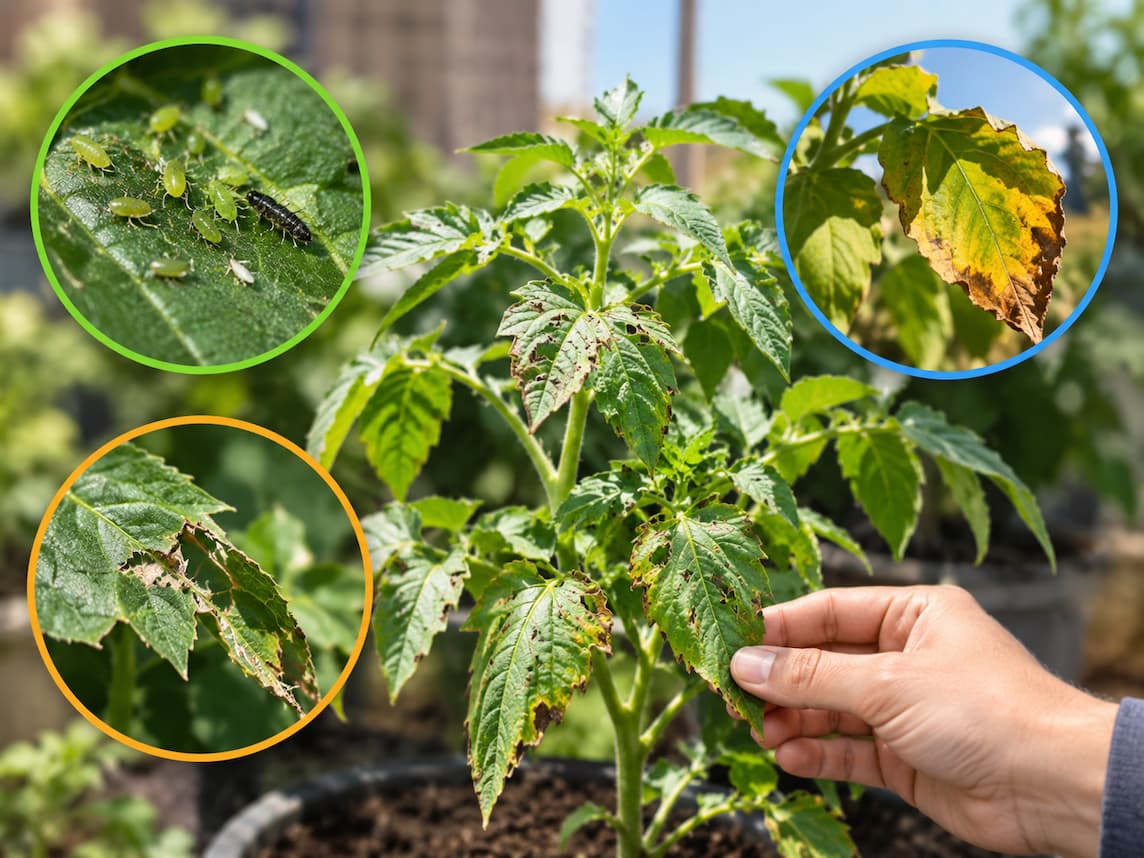
You notice a damaged leaf, and the first thought is often, “Something must be eating my plant.” That reaction is understandable, especially when the damage looks unusual. But visible damage rarely tells the whole story. A ragged edge can come from an insect, a careless movement, strong wind, or contact with a nearby object. Brown-looking tissue might result from environmental stress, while a scrape or bruise can later become discolored and look like a different kind of problem.
The most useful response is therefore not to treat the plant immediately. It is to investigate what happened. Plant damage leaves clues. Where it appears, how it is shaped, when it developed, whether it is spreading, and what has changed around the plant can help narrow down the possibilities. The goal is not to identify a cause from one symptom. It is to build a reasonable explanation from several pieces of evidence.
Start With the Damage, Not the Suspect
Before looking for insects or reaching for a treatment, examine the damaged area carefully. Ask what the tissue actually looks like. Is part of the leaf missing, or is the tissue still present but discolored? Does the surface look scraped, crushed, torn, dry, or distorted? Is the damage limited to one spot, following an edge, or scattered across the plant?
These distinctions matter because different types of events affect plant tissue differently. A clean tear through a leaf may have resulted from bending or catching the leaf on something. A rough scraped area could indicate rubbing against a wall, stake, pot edge, or another plant. Small missing sections may have several possible explanations, including feeding activity or physical tearing. Large dry-looking patches may reflect environmental conditions, but damaged tissue can also change appearance as it ages. The first observation should therefore be descriptive rather than diagnostic. Instead of saying, “This is pest damage,” start with, “There is an irregular damaged area near the edge of one mature leaf, and the surrounding tissue is still green.” That leaves room for the evidence to lead you toward the cause.
Location Is One of the Most Useful Clues
Look closely at where the damage occurs. Damage concentrated on leaves that touch a window, wall, railing, plant support, or neighboring foliage may have a physical explanation. A leaf repeatedly rubbing against a rough surface can develop marks that initially seem mysterious.
Damage on exposed leaves can also deserve a different interpretation from damage hidden inside dense foliage. Outdoor plants may experience wind movement, contact with structures, animals, or passing people. Indoor plants can be knocked, brushed against, moved, or damaged during cleaning.
The location of damage within the plant matters too. New growth is particularly useful evidence. Young leaves and shoots are still developing, so distortion there can point toward an issue that affected the plant while that tissue was forming. Damage on an older, fully developed leaf may instead reflect something that happened after the leaf had already matured.
Location does not prove a cause, but it can make some explanations more plausible than others.
Examine the Shape and Pattern
Next, look at the pattern rather than focusing on the color alone. Physical damage often has a connection to an obvious point of contact. You might see a crease, flattened section, abrasion, split, or tear extending from one part of the plant. A damaged stem may show a bend or break that corresponds to the direction in which it was pushed.
Pest-related damage can have repeated or irregular feeding patterns, but those patterns are not exclusive to pests. Environmental conditions can also affect several parts of a plant in ways that look patterned. This is why repeated damage deserves more attention than one unusual mark.
Suppose one leaf has a jagged section missing. There are many possible explanations. Now suppose similar fresh damage appears on several leaves, including leaves that are not close to any object. The investigation changes because the pattern is no longer isolated. Look for repetition, distribution, and relationship between damaged areas.
Fresh Damage Tells a Different Story From Old Damage
Plant tissue changes after it has been injured. A fresh tear may look very different from the same injury several days later. Bruised tissue can darken. A damaged area can dry out. A broken section can become more noticeable as the surrounding plant continues growing. This makes timing important. Try to determine whether you are looking at a new event or an old injury that has simply become easier to notice.
A useful clue is whether the damaged tissue has changed since you first saw it. Take a photograph if necessary and compare it after a day or two. The comparison is more informative than repeatedly examining the same mark without recording what it looked like before. A static scar that remains essentially unchanged points toward a completed event. New damage appearing beside the old mark tells a different story and deserves further investigation.
Has the Damage Appeared on One Plant or Many?
The number of affected plants can substantially change your diagnosis. Imagine moving a houseplant and accidentally knocking one leaf against a doorway. One damaged leaf on one plant is consistent with a localized physical event. Now imagine several plants in the same area developing similar damage around the same time. A single accidental impact becomes a less satisfying explanation. You should consider what those plants have in common, including their environment and exposure to potential pests.
The same principle applies outdoors. If only one plant has an unusual damaged area while nearby plants look normal, a localized event is worth considering. If several plants begin showing related changes, look for a shared condition. However, widespread damage does not automatically mean environmental stress, just as isolated damage does not automatically mean physical injury. The pattern helps you assign attention; it does not provide a verdict.
Look for Evidence Beyond the Leaf
The damaged tissue is only one part of the investigation. Inspect the plant and its immediate surroundings. Look underneath leaves, around stems, near growing points, and in sheltered areas. You are not simply looking for insects. You are looking for additional evidence that supports or weakens different explanations. For possible pest activity, the useful evidence might include visible insects, feeding activity, webbing associated with certain pests, residue, or repeated fresh damage. The absence of visible insects does not completely rule out pests, because some are small, hidden, or active at particular times.
- For physical damage, inspect nearby objects and conditions. Is a leaf pressed against a wall? Does a stem pass through a tight support? Could a curtain, pet, person, gardening tool, or falling object have contacted the plant?
- For environmental causes, consider the plant’s surroundings. Has its position changed? Has sunlight exposure increased? Has the plant recently been placed near a heat source, moved outdoors, or exposed to a substantially different airflow pattern?
The surrounding evidence often tells more than the damaged patch itself.
Three Broad Explanations to Compare
| Possible cause | Clues that may support it | Evidence that deserves caution |
|---|---|---|
| Pest-related damage | Repeated fresh damage, damage in multiple locations, visible insects or other supporting evidence, activity around leaves or stems | A single hole, tear, or mark by itself does not prove pest activity. |
| Physical or accidental damage | One localized injury, torn or crushed tissue, abrasion, bent stem, nearby object, or recent handling | Physical damage can later discolor and resemble other problems. |
| Environmental damage | Similar changes across exposed plant parts or several plants, timing after a change in conditions, damage associated with exposure | One damaged leaf does not automatically indicate an environmental problem. |
Think of these categories as competing explanations rather than fixed labels.
The best explanation is the one that accounts for the greatest amount of evidence without requiring you to ignore important clues.
The Decision Tree: Follow the Clues
When you discover unexplained damage, mentally work through a short series of questions.
1. Is the damage sharply localized?
Look around the affected area. A single torn or bruised leaf, especially after recent handling or movement, makes physical damage worth investigating first.
2. Does the damage appear repeatedly?
Fresh damage appearing on additional leaves changes the situation. Investigate the plant more carefully for ongoing causes, including pests or continuing environmental exposure.
3. Is there a clear contact point?
A scraped leaf beside a rough wall or a stem bent against a support has a plausible physical explanation. That explanation becomes stronger if the pattern matches the point of contact.
4. Are other plants affected?
Similar damage across several plants suggests looking for something they share. That could be a common environmental condition or a source of ongoing pest activity.
5. Did conditions recently change?
Think beyond major weather events. A plant may have been moved to a brighter location, placed beside a heater or air-conditioning outlet, exposed to stronger airflow, or transferred between indoor and outdoor conditions.
6. Can you find supporting evidence?
Look for insects and other signs when pest activity is a possibility. Look for contact points when physical damage is suspected. Look for changes in placement or growing conditions when environmental damage is being considered.
7. Is the damage still progressing?
This may be the most useful question of all. An injury that happened once may leave a lasting mark without creating new damage. An active cause is more likely to produce additional changes over time.
What Different Types of Damage Can Tell You
1. A Torn Leaf
A torn leaf is a good example of why appearance alone is unreliable. A leaf can tear when it is bent, caught on clothing, brushed against a rough surface, damaged by wind, or affected by feeding activity. Examine the tear’s location and surrounding tissue. If the tear corresponds to a recent handling event and no new damage appears, physical injury becomes a reasonable explanation. If fresh, unrelated damage continues appearing elsewhere, investigate further rather than assuming the original explanation applies to everything.
2. Scraped or Bruised Tissue
Scraping usually deserves an immediate search for contact. Check whether the leaf has been rubbing against a wall, window frame, plant support, pot edge, or another plant. Also consider whether the plant was recently transported or rearranged. A bruise may later become brown or dark, which can make an old physical injury look like a new physiological problem. The timing of the color change is therefore important.
3. Holes or Missing Sections
Missing tissue deserves more investigation because several causes can create similar results. Rather than treating every hole as proof of insects, examine whether the damage is fresh, whether other leaves are affected, and whether there is evidence of feeding activity. Because holes can also occur through tearing or other physical events, this observation should remain part of the broader investigation rather than becoming the entire diagnosis.
4. Scorched-Looking Areas
Dry, scorched-looking tissue can be especially misleading. Environmental exposure can contribute to this appearance, particularly when damage corresponds with a recent change in exposure or conditions. But previously injured tissue can also dry and discolor. Ask whether the plant experienced a meaningful environmental change and whether similarly exposed leaves show related damage. The pattern is more informative than the brown or dry appearance alone.
5. Distorted New Growth
When new growth develops abnormally, pay attention to when the distortion began. A developing leaf or shoot may be affected before it fully opens, so the final appearance does not necessarily reveal when the problem occurred. Look at other emerging growth and inspect the plant closely for additional evidence. Do not assume that distorted growth has one universal cause. Several stresses can affect developing tissue, and the investigation should consider both the plant’s recent conditions and any supporting evidence found on the plant.
6. Damaged Stems
Stem damage can provide particularly strong physical clues because stems can be bent, crushed, split, or broken through direct contact. Look for a bend, break, compression point, or connection with a support. Then consider whether the damage appeared after moving, pruning, tying, transporting, or rearranging the plant. If the stem continues developing new damage without an obvious physical event, broaden the investigation instead of assuming the original injury explains everything.
Case Example: One Damaged Leaf
Consider a plant with one leaf that suddenly has a torn section. The plant was recently moved, and the damaged leaf sits against the edge of a shelf. There are no similar injuries elsewhere, and the damage has not changed since it was noticed.
No single clue proves that the shelf caused the tear. But the combination of recent movement, a clear contact point, isolated damage, and no progression makes physical injury a strong working explanation. There is little reason to treat the plant for pests based on that observation alone.
Case Example: The Same Damage on Several Plants
Now imagine several plants develop damaged-looking areas over a period of days. The plants occupy the same bright area, and they were all moved closer to a window shortly before the damage appeared. The affected tissue is concentrated on exposed portions of the plants rather than on sheltered growth.
This pattern gives environmental conditions more weight in the investigation. It still does not prove that the new location caused the damage. But the timing, shared exposure, and distribution provide a stronger environmental explanation than a series of unrelated accidental injuries.
Case Example: Damage That Keeps Appearing
Suppose a plant has several damaged leaves. You remove one visibly affected leaf, but new damage appears on another leaf the next day. The important clue is not simply what the damage looks like. It is the fact that the problem is continuing.
At this point, inspect the plant carefully for evidence of an ongoing pest issue and review recent environmental changes. Also check whether something is repeatedly contacting the plant. The investigation should follow the progression rather than becoming anchored to the first explanation that came to mind.
Do Not Treat the First Plausible Explanation as the Final Answer
Good plant diagnosis involves eliminating explanations, not proving a theory from one visual clue. You may initially suspect pests because of damaged tissue, then find that the damage is confined to leaves rubbing against a rough surface. Or you may assume a leaf was physically damaged, only to discover fresh damage appearing on several plants.
Be willing to change your working explanation as new evidence appears. This is especially important before using a pest-control product. Treating an unidentified problem can waste effort and may expose the plant to an unnecessary treatment. First establish whether there is credible evidence of pest activity. If treatment eventually becomes appropriate, choose an option suitable for the identified problem and follow the product’s directions carefully.
A Practical Inspection Routine
When unexplained damage appears, pause before altering the plant.
- First, describe what you see without naming the cause. Then examine where the damage occurs and whether it has a recognizable pattern. Check whether the tissue is fresh, old, torn, scraped, bruised, missing, dry, or distorted.
- Next, inspect the plant itself and its surroundings. Look for insects or other supporting evidence, but also search for contact points, recent handling, supports, nearby objects, and changes in placement.
- Then compare the affected plant with nearby plants. Ask whether they share the same location, exposure, watering environment, airflow, or other recent change.
- Finally, monitor what happens next. A photograph can make this easier. Record the date and take another photograph after some time has passed. New damage, stable scars, or changes in distribution can help distinguish an isolated event from an active problem.
The purpose is not to reach a perfect diagnosis immediately. It is to avoid making a major decision from insufficient evidence.
Diagnostic Checklist for Unexplained Plant Damage
When you next notice damaged leaves, stems, or shoots, check:
- Where is the damage? Edge, center, stem, new growth, exposed side, or contact point?
- What does the tissue actually look like? Torn, scraped, bruised, missing, dry, or distorted?
- Is it fresh or old? Has the appearance changed since you first noticed it?
- How widespread is it? One leaf, one plant, or several plants?
- Is new damage appearing? Progression is important evidence.
- Can you find supporting evidence? Look for insects, contact points, or environmental changes.
- Was the plant recently moved or disturbed? Include transport, pruning, rearranging, and routine handling.
- Did conditions change? Consider light exposure, temperature, airflow, or location.
- Does the pattern make sense for one explanation? Do not ignore clues that point elsewhere.
- Have you observed enough before treating? Avoid acting solely because a symptom looks familiar.
Plant damage is often easier to understand when you stop asking, “What does this symptom mean?” and start asking, “What evidence can I find about what happened?”
A damaged leaf is only the starting point. Its location, pattern, age, progression, surroundings, and relationship to the rest of the plant can turn an unexplained mark into a much more reasonable diagnosis.