
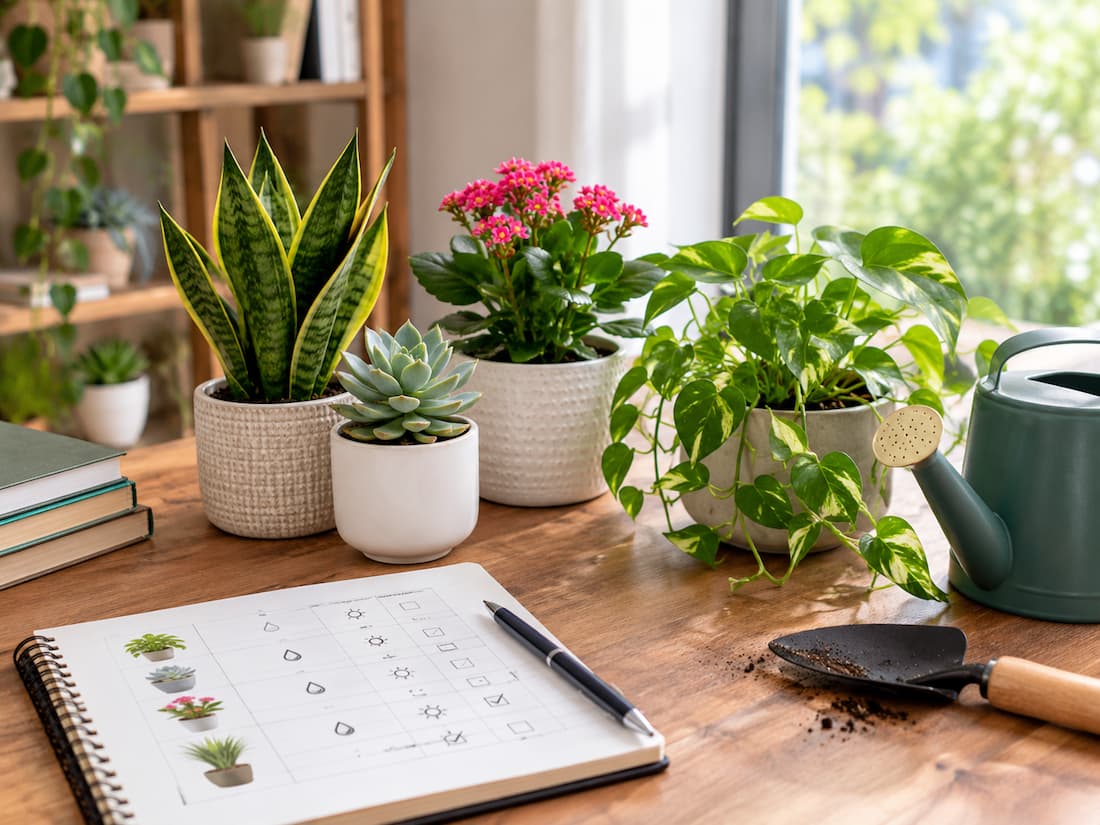
A plant can look easy in a garden center and still become difficult once it comes home. The label may describe it as low-maintenance, but that description rarely accounts for the person caring for it. A plant that suits someone who checks leaves every morning may be a poor choice for someone who travels for several days at a time. Another plant might be perfectly manageable for a gardener with a free Saturday afternoon but frustrating for someone who only has a few spare minutes during the week.
The problem is often not that the plant is unusually demanding. The problem is that its care rhythm does not match the owner’s routine. Instead of asking whether a plant is “easy,” it is more useful to ask what kind of attention the plant requires, how often that attention is needed, and what happens when care is delayed. This shifts the decision from a vague label to something practical: care demand.
Low maintenance depends on the person.
There is no single level of maintenance that makes a plant easy for everyone. Imagine two people buying the same attractive flowering plant. The first person works from home and enjoys checking plants each morning. They notice dry soil quickly, remove faded flowers, and adjust the plant’s position when the weather changes. The second person works long hours, travels regularly, and may not look at their plants for five or six days.
The plant has not changed. Their ability to meet its needs has. This is why plant descriptions such as “easy,” “beginner-friendly,” or “low maintenance” should be treated as starting points rather than guarantees. Such labels may describe a plant’s general toughness, but they do not necessarily tell you whether its watering schedule, growth rate, pruning requirements, or sensitivity to changing conditions fit your life.
A better match is a plant whose care requirements remain manageable even when your normal routine is taken into account.
Start with your actual routine, not your ideal routine.
When choosing a plant, it is tempting to imagine the version of yourself who will care for it perfectly. You may picture yourself checking the soil regularly, cleaning leaves, pruning at the right time, and remembering seasonal changes. That is not necessarily the routine you should use to choose plants. Instead, think about what you reliably do now.
Someone who already checks plants every day can comfortably manage plants that benefit from frequent observation. They may enjoy noticing new growth, adjusting watering, removing damaged leaves, and responding to small changes before they become larger problems. A person who can usually give plants attention once or twice a week needs a different type of plant. Occasional care is easier when the plant can tolerate some variation in moisture, does not require frequent pruning, and does not deteriorate quickly when a small task is postponed.
Someone who travels frequently has an even stronger reason to examine care intervals. A plant that needs attention every few days may create problems during every trip, even if it is otherwise considered easy. A plant that tolerates longer gaps between watering and does not depend heavily on stable daily conditions may be a more practical choice.
Then there is the forgetful gardener. If routine care is frequently missed, choosing a plant that needs frequent monitoring is likely to create unnecessary frustration. The better strategy is to look for characteristics that provide some tolerance when a task is forgotten. The goal is not to become a more disciplined plant owner. It is to choose plants that work with the routine you actually have.
The hidden workload behind a plant
Watering is usually the first care requirement people notice, but it is only one part of the workload. A plant can have moderate watering needs and still demand considerable attention because it grows rapidly, needs regular pruning, attracts pests easily, or requires frequent repositioning to maintain suitable light. Think about care as a collection of recurring tasks.
Some plants need frequent checks because changes in soil moisture matter quickly. Others can tolerate longer intervals. Some grow slowly and remain compact for a long time, while fast-growing plants can turn pruning into a regular chore. Certain plants shed old leaves or flowers that need occasional cleaning. Others may need feeding during active growth and a different routine during cooler or darker periods. Repotting is another part of the long-term workload. A plant that grows quickly may outgrow its container sooner than a slow-growing one. That does not make the fast-growing plant bad, but it means the owner needs to be prepared for more physical maintenance over time.
Environmental consistency also matters. A plant may cope well with a particular range of conditions but respond poorly when light, temperature, humidity, or watering patterns change frequently. For someone who can provide a stable environment, this may not be a problem. For someone whose home conditions vary substantially, the same plant can require much more monitoring. Care demand is therefore better understood as the total amount of attention a plant is likely to consume over time.
A week in the life of different gardeners
Consider someone who checks plants every morning before leaving for work. They notice that one container is drying faster than another and can respond before the difference becomes serious. They may also enjoy pruning and cleaning as part of their routine. For this gardener, a plant with moderate monitoring needs may be perfectly reasonable. Frequent observation is not a burden because checking plants is already part of the person’s normal schedule.
Now consider someone who only has time on Wednesday and Sunday evenings. Their plants need to cope with the gap between those visits. Characteristics such as slower growth, less sensitivity to short delays, and less frequent pruning become more valuable. A frequent traveler faces a different problem. Even if they are willing to care for plants when home, they cannot provide attention during every trip. In this situation, the important question is not simply, “How often does this plant usually need water?” It is, “What happens if I cannot check it for several days?”
A person who frequently forgets routine tasks should also pay attention to the consequences of missed care. A plant that declines quickly after one missed task may create a cycle of rescue and recovery. A more forgiving plant gives the owner more room for an imperfect schedule. Finally, imagine someone with a large collection who only has Saturday afternoon available. Their challenge is cumulative. One plant might be easy, but twenty plants with different watering schedules, pruning needs, and seasonal requirements can become a complicated management system.
For this gardener, consistency is often more valuable than individual plant toughness. Plants with broadly similar care rhythms may be easier to manage than a collection containing many different schedules.
Look beyond the care label before buying.
A plant’s care information is much more useful when you turn general descriptions into specific questions. Start with watering. Find out whether the plant prefers consistently moist conditions, allows the growing medium to dry between waterings, or has more specific requirements. Then consider how quickly its container and growing conditions are likely to dry. The same plant can behave differently depending on container size, temperature, light, airflow, and growing medium.
Next, examine growth rate. Rapid growth can be attractive, but it may also mean more pruning, more frequent repotting, or more space management. Slow growth often reduces some of these tasks, although it does not automatically mean the plant is easy. Pruning deserves similar attention. Ask whether pruning is occasional maintenance or something that is likely to become part of the plant’s regular appearance and size management. A plant that quickly becomes leggy or spreads beyond its intended space may demand more intervention than its “easy-care” label suggests.
It is also worth asking how commonly the plant develops problems under ordinary growing conditions. You do not need to assume that every pest or disease will occur, but a plant that requires close observation to catch problems early may be a different workload from one that is generally tolerant of minor lapses.
Light tolerance should also be considered realistically. A plant described as tolerant of lower light may survive there without necessarily looking its best. If keeping it attractive requires frequent repositioning, supplemental lighting, or close observation, its practical care demand may be higher than expected. Finally, consider size. A small plant can be easy to manage today but considerably harder when it becomes large. Before buying, ask what the plant is likely to look like after several seasons and whether you have the space and willingness to manage it at that size.
Seasonal care can change the bargain.
A plant’s care demand is rarely identical throughout the year. Growth may accelerate during a favorable season, increasing watering or pruning requirements. During a slower period, watering may need to become less frequent. Changes in indoor light can also affect how quickly a container dries and how actively a plant grows.
Imagine a gardener who has plenty of free time during summer but very little during the rest of the year. A plant whose busiest care period coincides with the gardener’s busiest season may be a poor practical match, even if its overall requirements are considered modest.
Seasonal changes are particularly important for people who prefer predictable routines. If you want a simple weekly schedule, a plant with major changes in watering, feeding, pruning, or positioning may require more attention than you expected. Before buying, look at the plant’s care across the year rather than only its current appearance.
Two attractive plants can create completely different workloads
Suppose you are choosing between two plants that both look good in a bright room. Plant A grows slowly, stays relatively compact, and does not require frequent shaping. Its soil can be allowed to dry somewhat between waterings, and a missed check does not immediately create a serious problem.
Plant B grows rapidly and produces vigorous new growth. It needs more regular observation because its moisture needs change with active growth, and keeping its shape may require periodic pruning. It may eventually need a larger container as well.
Neither plant is inherently better. For someone who enjoys daily plant care, Plant B could be more satisfying. The extra growth provides something to observe and manage. For someone with limited weekend time, Plant A may be the better choice because its slower pace reduces the number of decisions and interventions required. The important difference is not appearance. It is workload.
Make a care-demand assessment before adding another plant
Before buying a plant, give its care requirements a simple reality check. You do not need a complicated scoring system. The purpose is to expose a mismatch before the plant comes home.
Ask yourself:
- How often can I realistically check this plant?
- What happens if I miss one scheduled care session?
- Does it need consistently timed watering, or can its schedule vary somewhat?
- How quickly does it grow?
- Will it need regular pruning to remain the size and shape I want?
- How often might it need repotting as it grows?
- Does it require close monitoring for common problems?
- Can I provide its preferred light without constantly moving it?
- Will its care requirements change significantly by season?
- How much cleaning, feeding, and general maintenance am I realistically willing to do?
- If I am away for several days, what will happen to the plant?
- If I add several plants with similar needs, will caring for them together be straightforward?
The answers should be based on your normal week, not your best week.
Match the plant to your available attention
Once you think in terms of care demand, plant shopping becomes less about finding a universally easy plant and more about finding a suitable workload. If you enjoy daily observation, you can consider plants that reward regular attention and have more active growth or more frequent maintenance. If you have only one or two reliable care periods each week, favor characteristics that tolerate longer intervals and do not require constant intervention.
If travel is a major part of your routine, prioritize plants whose needs do not become critical during short absences. If forgetting is your biggest challenge, look closely at how forgiving a plant is when care is delayed. If you have a large collection but only one weekly maintenance window, consistency between plants can be more useful than adding another unusual species with a completely different routine. This approach also prevents a common mistake: adding plants because they are individually attractive without considering the combined workload. Five plants with five different schedules can demand more mental attention than five plants with broadly similar requirements.
The best low-maintenance choice is therefore not necessarily the plant with the fewest care tasks on paper. It is the plant whose care tasks fit naturally into the time you can consistently provide. A plant should fit your schedule well enough that ordinary care feels manageable, including during busy weeks, travel, changing seasons, and periods when your attention is elsewhere. When the plant’s needs and your routine are compatible, the label “low maintenance” becomes much more meaningful.