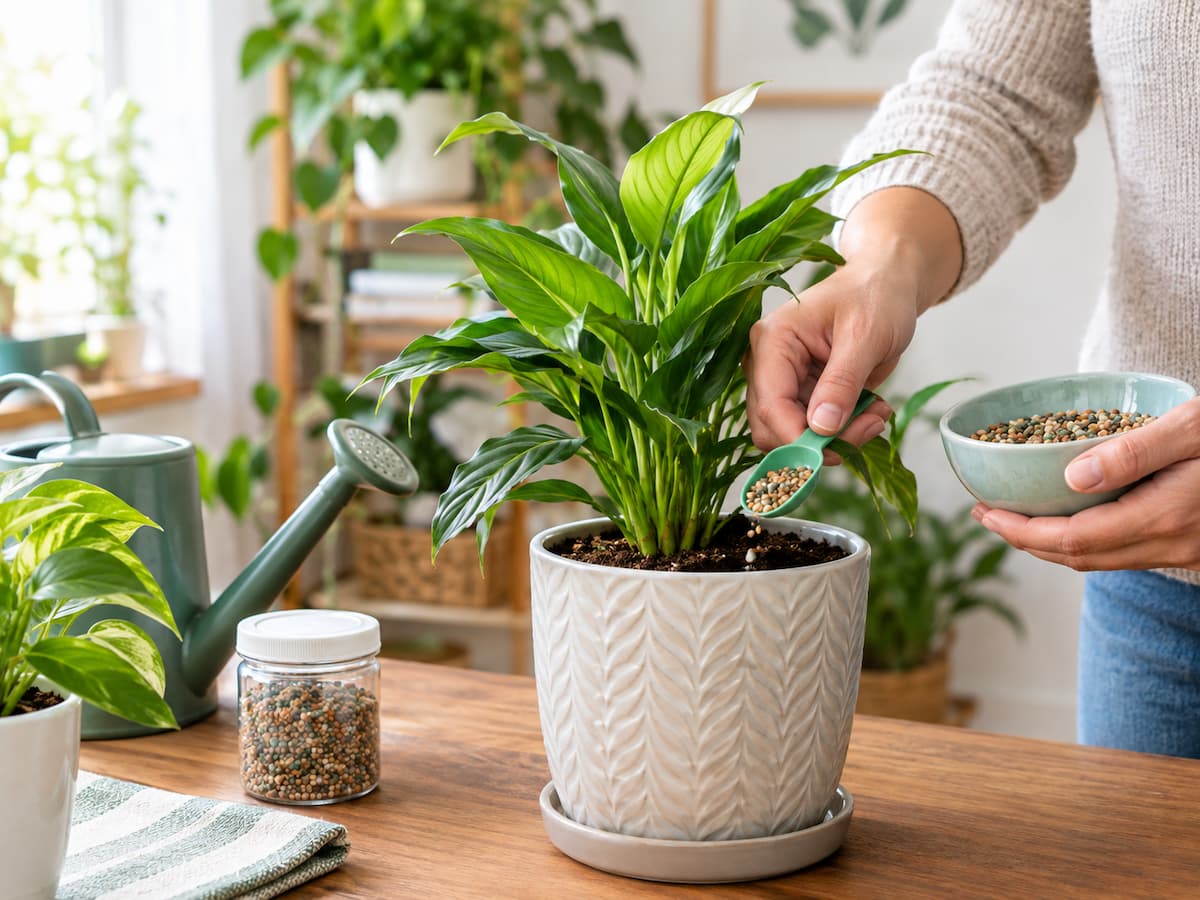
A houseplant starts looking weak, pale, or smaller than usual, and the first reaction is often to reach for fertilizer. It seems logical: if a plant is not growing well, perhaps it needs more nutrients. But adding fertilizer to a struggling plant can sometimes make the situation worse. Fertilizer supplies nutrients, but it cannot correct every problem that causes poor growth. A plant may be receiving too little light, staying wet for too long, or dealing with unsuitable growing conditions. Adding nutrients on top of those problems does not necessarily help. In some cases, excess fertilizer can accumulate in the growing medium and damage roots. Indoor plant fertilizing is therefore less about following a fixed calendar and more about understanding when additional nutrients are actually useful, how much to apply, and what the plant is telling you afterward.
What Does Fertilizer Actually Provide?
Plants need several essential mineral nutrients to build leaves, roots, stems, flowers, and other tissues. Fertilizers provide some of these nutrients in forms that plants can absorb through their roots. The three numbers commonly printed on a fertilizer container represent nitrogen, phosphorus, and potassium, in that order. These are often described as the N-P-K values. Nitrogen is associated with leafy growth, phosphorus plays important roles in energy transfer and reproductive processes, and potassium contributes to several functions, including water regulation and overall plant metabolism.
Commercial fertilizers can also contain secondary nutrients and micronutrients. The exact contents vary between products. This does not mean a plant benefits from receiving as much fertilizer as possible. Nutrients are useful within appropriate amounts. Once the plant has access to what it needs, adding substantially more does not automatically make growth faster or healthier. Fertilizer should be thought of as a supplement to an appropriate growing environment, not as plant food that compensates for every other deficiency in care.
Why Do Indoor Plants Need Different Feeding Decisions?
A plant growing outdoors may have access to a much larger volume of soil, natural nutrient cycling, rain, organic matter, and biological activity around its roots. A houseplant usually lives in a relatively small container with a limited amount of growing medium. At the same time, indoor conditions can vary considerably. A plant receiving strong natural light may actively produce new growth, while the same species in a dim room may grow very slowly.
Temperature, season, container size, growing medium, watering habits, and plant species all influence how quickly nutrients are used or become available. This is why two plants sitting in the same room do not necessarily need identical fertilizer treatment. A rapidly growing plant in favorable conditions may benefit from supplemental nutrients, while a slow-growing plant in lower light may require much less. The amount of fertilizer that is appropriate is connected to what the plant is actually doing, not simply to its presence inside a pot.
Should You Fertilize a Plant That Is Growing Poorly?
Not necessarily. Poor growth is one of the situations in which people are most likely to overuse fertilizer. A plant that looks weak can have many possible problems, and nutrient shortage is only one possibility. Before feeding, consider whether the plant is currently producing new leaves, stems, roots, or flowers. If it is actively growing and has been in the same growing medium for a substantial period, supplemental fertilizer may make sense.
If the plant is severely stressed, recently moved, suffering from damaged roots, or otherwise declining for an unclear reason, fertilizer should not automatically be used as a rescue treatment. A stressed root system may not benefit from receiving additional nutrients. In some circumstances, excess soluble salts in the growing medium can create additional root stress. The better question is not, “Does this plant look unhealthy, so should I fertilize it?” Instead ask, “Is there a reasonable reason to believe supplemental nutrients are appropriate right now?”
When Is Fertilizer More Likely to Be Useful?
Fertilizing is generally most relevant when a plant is actively growing and the nutrients available in its growing medium are becoming insufficient for continued healthy growth. Plants that are producing new leaves or other growth may use nutrients more actively than plants that are barely growing. This is one reason many houseplant owners do most of their feeding during periods of active growth rather than treating fertilizer as something that must be applied continuously.
The growing medium also matters. Some commercial potting mixes contain nutrients that are available for a period after planting. A plant that has recently been potted into a nutrient-containing mix may not need additional fertilizer immediately. There is no single waiting period that applies to every potting medium. Check the product information when available, because different mixes are formulated differently. A newly repotted plant may therefore already have access to nutrients. Adding fertilizer immediately can be unnecessary, particularly if the plant is not yet actively growing.
What Does the Fertilizer Label Tell You?
The label is more important than the instinct to “add a little extra.” Different fertilizers have different concentrations and application instructions. A product designed to be diluted may be intended for use at a particular amount per volume of water. Another product may have completely different instructions.
Common label information includes:
| Label information | What it tells you |
|---|---|
| N-P-K numbers | The relative amounts of nitrogen, phosphorus, and potassium in the fertilizer |
| Dilution rate | How much fertilizer should be mixed with a specified amount of water |
| Application frequency | How often the manufacturer recommends applying the product |
| Plant-use instructions | Which plants or growing situations the product is intended for |
| Additional nutrients | Other nutrients included beyond nitrogen, phosphorus, and potassium |
| Precautions | Handling, storage, or application warnings |
Pay attention to whether the instructions are based on the amount of concentrate, the final volume of diluted solution, or another measurement.
If the label says to dilute the product before use, that dilution is part of the application instructions, not merely a suggestion for convenience.
Why Does Dilution Matter So Much?
A concentrated fertilizer solution can expose roots to a much higher level of dissolved nutrients than intended. Using twice as much concentrate does not mean a plant will grow twice as quickly. Instead, the additional salts can increase the concentration of dissolved substances around the roots. Depending on the product, growing medium, drainage, and plant, this can contribute to root stress and leaf damage.
This is particularly important with container plants because their growing environment is restricted to a relatively small volume of material. When measuring fertilizer, avoid estimating by eye if the label provides a specific measurement. Follow the product’s instructions and use an appropriate measuring method. If you are uncertain about a product’s instructions, check the manufacturer’s label or documentation rather than improvising a stronger mixture.
Does Feeding More Often Produce Faster Growth?
Not reliably. Frequency matters because nutrients can accumulate in a container, particularly when plants are repeatedly fertilized without sufficient opportunity for excess soluble material to leave the growing medium. A small amount applied appropriately may be reasonable, while repeated applications can gradually increase the nutrient load.
This is one reason a fertilizer routine should take the plant’s current growth into account. A plant actively producing new growth may have a greater demand for nutrients than one that has slowed down considerably. Season can also influence the decision. Many indoor plants respond to changes in light and temperature throughout the year. A plant that grows vigorously during brighter months may slow substantially when conditions become less favorable.
Rather than continuing the same feeding pattern automatically, observe whether the plant is actually growing.
Do All Indoor Plants Need the Same Fertilizer?
No.
Different plants have different nutritional requirements and different tolerances for growing conditions. Some houseplants are naturally vigorous growers, while others are adapted to slower growth or specialized environments. A foliage plant, flowering houseplant, succulent, cactus, and other specialized plants may not respond identically to the same fertilizer approach.
This does not mean every plant needs a completely different and complicated feeding system. It means you should avoid assuming that one concentration and frequency is automatically suitable for everything in your home. Start with the fertilizer’s intended use and the plant’s requirements. If a product is specifically formulated for a certain group of plants, follow its directions rather than applying a stronger general-purpose mixture simply because another plant seemed to tolerate it.
How Can You Tell If You Have Overfertilized?
One of the most useful clues is timing. If a plant begins showing unusual problems shortly after repeated or excessive fertilizer applications, overfertilization becomes one possibility worth investigating. But symptoms alone rarely provide a definitive diagnosis.
1. Look for Fertilizer Residue or Salt Buildup
A crusty or powdery white deposit on the surface of the growing medium or around the edge of a container can indicate accumulated soluble salts. Fertilizer can be one source, although water quality and other materials can also contribute to mineral deposits. Visible residue is therefore a useful clue, not automatic proof that fertilizer caused the plant’s decline.
2. Watch for Leaf-Edge or Leaf-Tip Damage
Brown, dry-looking leaf margins or tips can occur when a plant is exposed to excessive soluble salts, but similar symptoms can result from several other causes. Consider what changed before the damage appeared. Was fertilizer recently increased? Was a concentrated mixture accidentally used? Has the plant been fertilized repeatedly? The pattern and timing are more informative than looking at a single damaged leaf.
3. Pay Attention to an Unexpected Decline After Feeding
If a previously stable plant suddenly begins declining after an unusually heavy fertilizer application, that connection deserves attention. However, avoid assuming that fertilizer is responsible simply because the timing overlaps. Changes in watering, temperature, light exposure, pests, root problems, or other environmental factors can also cause sudden deterioration. Good diagnosis involves looking at the whole situation rather than matching one symptom to one cause.
What Should You Do If You Suspect Overfertilization?
First, stop adding fertilizer while you assess the situation. Continuing to feed a declining plant makes it harder to determine whether the existing nutrient load is contributing to the problem. Then consider the condition of the growing medium and the container.
If excessive soluble salts are suspected, flushing the growing medium with an appropriate amount of plain water can sometimes help move soluble material out of the container. However, this is not a universal remedy. The container needs adequate drainage for flushing to make sense. A pot with blocked drainage or a plant that cannot tolerate prolonged wet conditions should not simply be flooded without considering the consequences.
The type of growing medium, plant species, container design, water quality, and severity of the situation all matter. If the plant is already suffering from serious root problems or the growing medium remains saturated, repeatedly adding water may create a different problem. In those circumstances, the appropriate response may require closer examination of the roots and growing conditions rather than repeated flushing. After addressing suspected excess fertilizer, allow the plant to recover under suitable conditions and avoid immediately restarting a heavy feeding routine.
Common Fertilizing Mistakes to Avoid
1. Using fertilizer as a rescue treatment.
A weak-looking plant is not automatically hungry. Fertilizer cannot substitute for appropriate growing conditions, and adding it to a stressed plant can sometimes increase problems.
2. Ignoring concentration.
The amount of concentrate used matters. A fertilizer’s dilution instructions should be followed rather than adjusted upward because more seems beneficial.
3. Feeding too frequently.
Repeated applications can contribute to nutrient and salt accumulation in containers, particularly when the plant is using nutrients slowly.
4. Treating every houseplant identically.
Plant type, growth rate, growing medium, and environmental conditions can all affect feeding needs.
5. Assuming more fertilizer means more growth.
Plants have nutritional requirements, not an unlimited appetite for fertilizer. Excess nutrients can become a source of stress rather than an advantage.
6. Continuing a routine when growth has slowed.
A calendar-based habit can become disconnected from what the plant actually needs. Changes in season and growing conditions can change the usefulness of supplemental feeding.
What About Plants That Have Just Been Repotted?
Repotting often creates the mistaken impression that a plant immediately needs fertilizer because its old growing medium has been replaced. In reality, the opposite may be true. Many commercial growing mixes contain nutrients intended to support plants for a period after potting. Check the growing medium’s packaging if you still have it. If it already contains a nutrient charge, adding fertilizer immediately may be unnecessary. The plant may also need time to settle into its new container. Avoid treating repotting as an automatic signal to begin a stronger feeding routine. Once the plant resumes active growth and the available nutrients in the growing medium become less adequate, supplemental fertilizer may become appropriate according to the needs of that particular plant and product.
A Better Way to Decide When to Feed
Instead of asking whether it is “fertilizer day,” look at several pieces of evidence together. Is the plant actively growing? Has it been in the same nutrient-containing growing medium for a while? Does the fertilizer label support its intended use? Have you already been feeding regularly? Is there any indication of salt accumulation or previous overfertilization?
These questions help separate a genuine need for supplemental nutrients from the common urge to intervene whenever a plant looks imperfect. If the plant is growing well, there may be no reason to increase feeding simply because more fertilizer is available. If growth has slowed, investigate the situation before assuming a nutrient shortage. And if overfertilization is suspected, adding still more fertilizer is clearly unlikely to solve the underlying problem.
The Goal Is Appropriate Nutrition, Not Maximum Feeding
Healthy indoor plants do not need to be constantly pushed with fertilizer. They need an appropriate supply of nutrients that matches their growth and growing conditions. Fertilizer is most useful when it fills a genuine nutritional gap. It becomes less useful when it is used automatically, applied too strongly, or treated as a solution for every sign of poor growth.
A sensible approach is to observe the plant, consider its current growth and growing medium, read the fertilizer label carefully, and use only the amount and frequency appropriate for the situation. If something goes wrong, timing and evidence are more useful than guessing from a single symptom. The best fertilizer decision is often not “How much more can I give this plant?” It is “Does this plant need supplemental nutrients right now, and if so, what does the label indicate is an appropriate amount?” That small change in thinking can prevent overfeeding while keeping fertilizer in its proper role: a useful supplement, rather than a substitute for good plant care.